.jpg)


A novel deep learning model for breast lesion classification using ultrasound Images: A multicenter data evaluation
Purpose: Breast cancer is one of the major reasons of death due to cancer in women. Early diagnosis is the most critical key for disease screening, control, and reducing mortality. A robust diagnosis relies on the correct classification of breast lesions. While breast biopsy is referred to as the "gold standard" in assessing both the activity and degree of breast cancer, it is an invasive and time-consuming approach.
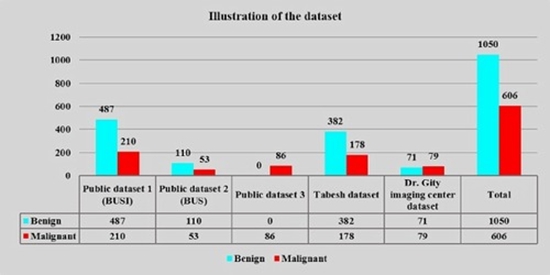
Method: The current study's primary objective was to develop a novel deep-learning architecture based on the InceptionV3 network to classify ultrasound breast lesions. The main promotions of the proposed architecture were converting the InceptionV3 modules to residual inception ones, increasing their number, and altering the hyperparameters. In addition, we used a combination of five datasets (three public datasets and two prepared from different imaging centers) for training and evaluating the model.
Results: The dataset was split into the train (80%) and test (20%) groups. The model achieved 0.83, 0.77, 0.8, 0.81, 0.81, 0.18, and 0.77 for the precision, recall, F1 score, accuracy, AUC, Root Mean Squared Error, and Cronbach's α in the test group, respectively.
Conclusions: This study illustrates that the improved InceptionV3 can robustly classify breast tumors, potentially reducing the need for biopsy in many cases.
Keywords: Breast ultrasound; Convolutional neural network; Deep learning; Image classification.


