.jpg)


Clinical and chest CT features as a predictive tool for COVID-19 clinical progress: introducing a novel semi-quantitative scoring system
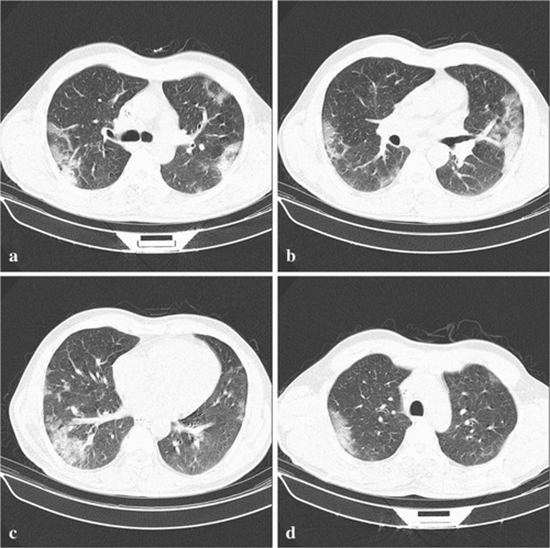
Objective: Proposing a scoring tool to predict COVID-19 patients' outcomes based on initially assessed clinical and CT features.
Methods: All patients, who were referred to a tertiary-university hospital respiratory triage (March 27-April 26, 2020), were highly clinically suggestive for COVID-19 and had undergone a chest CT scan were included. Those with positive rRT-PCR or highly clinically suspicious patients with typical chest CT scan pulmonary manifestations were considered confirmed COVID-19 for additional analyses. Patients, based on outcome, were categorized into outpatient, ordinary-ward admitted, intensive care unit (ICU) admitted, and deceased; their demographic, clinical, and chest CT scan parameters were compared. The pulmonary chest CT scan features were scaled with a novel semi-quantitative scoring system to assess pulmonary involvement (PI).
Results: Chest CT scans of 739 patients (mean age = 49.2 ± 17.2 years old, 56.7% male) were reviewed; 491 (66.4%), 176 (23.8%), and 72 (9.7%) cases were managed outpatient, in an ordinary ward, and ICU, respectively. A total of 439 (59.6%) patients were confirmed COVID-19 cases; their most prevalent chest CT scan features were ground-glass opacity (GGO) (93.3%), pleural-based peripheral distribution (60.3%), and multi-lobar (79.7%), bilateral (76.6%), and lower lobes (RLL and/or LLL) (89.1%) involvement. Patients with lower SpO2, advanced age, RR, total PI score or PI density score, and diffuse distribution or involvement of multi-lobar, bilateral, or lower lobes were more likely to be ICU admitted/expired. After adjusting for confounders, predictive models found cutoffs of age ≥ 53, SpO2 ≤ 91, and PI score ≥ 8 (15) for ICU admission (death). A combination of all three factors showed 89.1% and 95% specificity and 81.9% and 91.4% accuracy for ICU admission and death outcomes, respectively. Solely evaluated high PI score had high sensitivity, specificity, and NPV in predicting the outcome as well.
Conclusion: We strongly recommend patients with age ≥ 53, SpO2 ≤ 91, and PI score ≥ 8 or even only high PI score to be considered as high-risk patients for further managements and care plans.
Key points: • Chest CT scan is a valuable tool in prioritizing the patients in hospital triage. • A more accurate and novel 35-scale semi-quantitative scoring system was designed to predict the COVID-19 patients' outcome. • Patients with age ≥ 53, SpO2 ≤ 91, and PI score ≥ 8 or even only high PI score should be considered high-risk patients.


