.jpg)


Percutaneous Sclerotherapy with Bleomycin and Ethiodized Oil: Is It a Promising Treatment for Giant Liver Hemangioma?
Background
Percutaneous sclerotherapy with bleomycin has been proven to have a potential benefit in the management of low-flow venous malformations. Liver hemangiomas are considered low-flow venous malformations. Thus, percutaneous sclerotherapy could potentially have a promising result in their management.
Purpose
To investigate the feasibility, efficacy, and safety of percutaneous sclerotherapy with bleomycin in the management of symptomatic giant liver hemangioma (GLH).
Materials and Methods
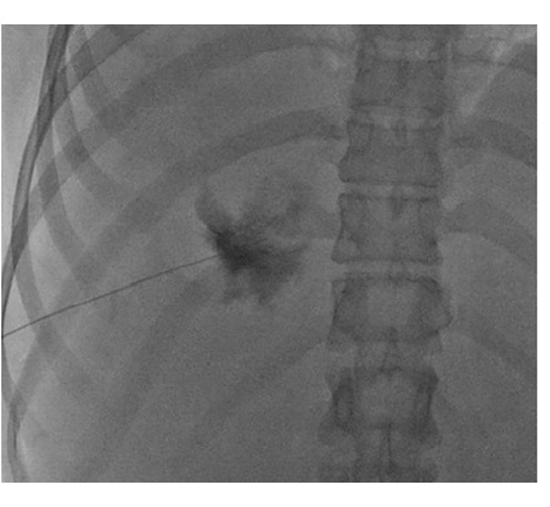
This single-institute prospective study was conducted between September 2018 and July 2020. Percutaneous sclerotherapy was performed using a mixture of bleomycin and ethiodized oil under guidance of US and fluoroscopy in participants with GLH who were experiencing related abdominal pain or fullness. Technical success was recorded. Change in symptom severity, according to visual analog scale (VAS), was considered the primary outcome of the study. Volume change, based on the lesion volume at CT, and complications, based on the classification of the Society of Interventional Radiology, were regarded as secondary outcomes. The primary and secondary outcomes were recorded 6 and 12 months after the procedure. Comparison was performed by using the Wilcoxon signed-rank test or paired t test.
Results
Twenty-eight participants (mean age, 45 years ± 9; 25 women) were evaluated. Technical success was 100%. The mean VAS score was 8.3 before the procedure, which decreased to 1.4 (84.7% reduction) and 1.5 (83.5% reduction) at 6- and 12-month follow-ups, respectively (P < .001 for both). All participants reported relief of symptoms (17 of 28 participants [61%] with complete relief; 11 [39%] with partial relief) at 12-month follow-up. Mean GLH volumes dropped from 856.3 cm3 to 309.8 cm3 (65.7% reduction) and 206.0 cm3 (76% reduction) at 6- and 12-month follow-ups, respectively (P < .001 for both). No major complications were detected.
Conclusion
Percutaneous sclerotherapy is a safe and feasible method with promising results in the treatment of patients with symptomatic giant liver hemangioma.


