.jpg)


A DTI Radiomics Study of Language Network Features Predicting Conversion from Mild Cognitive Impairment to Alzheimer’s Disease
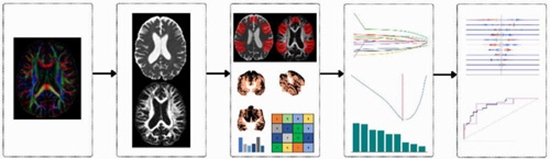
Background Mild cognitive impairment (MCI) precedes Alzheimer’s disease (AD) in ∼40% of cases, with early language deficits distinguishing converters. This study develops a DTI radiomics model from language network gray matter to predict MCI to AD conversion and identify preclinical biomarkers.
Methods This retrospective case-control study analyzed diffusion tensor imaging (DTI) data from 97 individuals with MCI (29 converters, 68 non-converters) from the Alzheimer’s Disease Neuroimaging Initiative (ADNI). Ethical approval and participant consent were obtained by ADNI. Radiomic features were extracted from fractional anisotropy (FA) and mean diffusivity (MD) maps within language network gray matter. A logistic regression model using eleven selected features performed classification. Performance was evaluated using area under the receiver operating characteristic curve (AUC). Radiomic–cognitive associations were analyzed using Pearson correlations; group differences were assessed with Fisher’s r-to-z transformation.
Results The model achieved cross-validation AUC = 0.84 and test AUC = 0.83. SHAP analysis identified two top predictors: lower right temporal pole original_glcm_Correlation_FA and higher right frontal orbital cortex original_glszm_SmallAreaHighGrayLevelEmphasis_FA. Right frontal orbital cortex original_glszm_SmallAreaHighGrayLevelEmphasis_FA correlated positively with ADAS-Q4 in non-converters (r = 0.27, p < 0.001) but negatively in converters (r = –0.48, p < 0.001).
Conclusions A DTI radiomics model achieved AUC = 0.83 for predicting MCI to AD conversion, with bilateral language network microstructural features showing group-specific cognitive associations, supporting their potential as early Alzheimer’s risk biomarkers.


