Advanced Diagnostic & Interventional Radiology Research Center | A DTI Radiomics Study of Language Network Featuresin in Alzheim

Advanced Diagnostic & Interventional Radiology Research Center | A DTI Radiomics Study of Language Network Featuresin in Alzheim
| Aug 3 2026
logo

Advanced Diagnostic & Interventional Radiology Research Center

COVID-19 pandemic 

During the COVID-19 pandemic, the Radiology Research Center at Tehran University of Medical Sciences continued its research activities despite the challenges posed by the increased demand for CT scans of COVID-19 patients and the necessity of adhering to strict health protocols. This center played a crucial role in improving medical imaging techniques, optimizing diagnostic protocols, and advancing technologies related to CT scan image analysis.

Faculty members, researchers, and staff remained committed to ensuring the safety and well-being of healthcare professionals and patients while actively engaging in imaging data analysis, developing artificial intelligence algorithms for faster disease detection, publishing scientific articles, and presenting their findings at international conferences. These efforts aimed to enhance diagnostic accuracy, improve treatment processes, and alleviate pressure on healthcare systems.


Key achievements of the Radiology Research Center during the COVID-19 pandemic include:


✔️ Development and optimization of lung imaging protocols for faster and more accurate COVID-19 diagnosis
✔️ Implementation of artificial intelligence technologies for automated CT scan analysis and reduced diagnosis time
✔️ Publication of high-impact research articles on innovative imaging methods for COVID-19 patients
✔️ Participation in national and international projects focused on COVID-19 diagnosis and patient management

The center remains dedicated to advancing research in medical imaging and continues to contribute as a leading scientific institution in improving the quality of diagnostic and therapeutic services.


Some of the center's significant achievements during the pandemic include:


  • Release Date : Jun 16 2026 - 10:38
  • : 6
  • Study time : 1 minute(s)

A DTI Radiomics Study of Language Network Features Predicting Conversion from Mild Cognitive Impairment to Alzheimer’s Disease
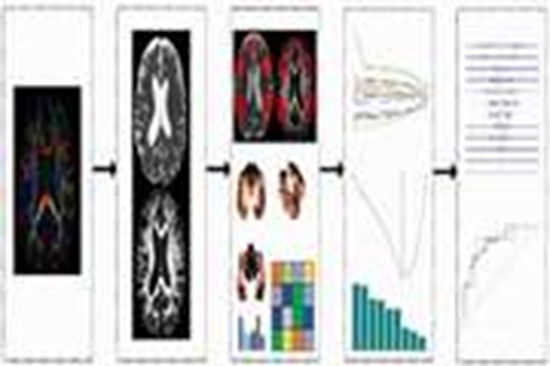
A DTI Radiomics Study of Language Network Featuresin in  Alzheimer’s Disease {faces}

Background Mild cognitive impairment (MCI) precedes Alzheimer’s disease (AD) in ∼40% of cases, with early language deficits distinguishing converters. This study develops a DTI radiomics model from language network gray matter to predict MCI to AD conversion and identify preclinical biomarkers.

Methods This retrospective case-control study analyzed diffusion tensor imaging (DTI) data from 97 individuals with MCI (29 converters, 68 non-converters) from the Alzheimer’s Disease Neuroimaging Initiative (ADNI). Ethical approval and participant consent were obtained by ADNI. Radiomic features were extracted from fractional anisotropy (FA) and mean diffusivity (MD) maps within language network gray matter. A logistic regression model using eleven selected features performed classification. Performance was evaluated using area under the receiver operating characteristic curve (AUC). Radiomic–cognitive associations were analyzed using Pearson correlations; group differences were assessed with Fisher’s r-to-z transformation.

Results The model achieved cross-validation AUC = 0.84 and test AUC = 0.83. SHAP analysis identified two top predictors: lower right temporal pole original_glcm_Correlation_FA and higher right frontal orbital cortex original_glszm_SmallAreaHighGrayLevelEmphasis_FA. Right frontal orbital cortex original_glszm_SmallAreaHighGrayLevelEmphasis_FA correlated positively with ADAS-Q4 in non-converters (r = 0.27, p < 0.001) but negatively in converters (r = –0.48, p < 0.001).

Conclusions A DTI radiomics model achieved AUC = 0.83 for predicting MCI to AD conversion, with bilateral language network microstructural features showing group-specific cognitive associations, supporting their potential as early Alzheimer’s risk biomarkers.

  • Article_DOI : doi.org/10.64898/2026.01.29.26345
  • Author(s) : fatemeh jamshidian
  • News Group : research,research article,AI
  • News Code : 323637
نفیسه سادات قوامی
Author:

نفیسه سادات قوامی

0 Comments for this article

comment

Post your comment:

متن درون تصویر را در جعبه متن زیر وارد نمائید *
Enter your desired term to search
Theme settings