Advanced Diagnostic & Interventional Radiology Research Center | A Systematic Review and Meta Analysis of Complications Associated with Autogenous Diced Cartilage Wrapped in Fascia Used in Nasal Dorsum Augmentation
Advanced Diagnostic & Interventional Radiology Research Center | A Systematic Review and Meta Analysis of Complications Associated with Autogenous Diced Cartilage Wrapped in Fascia Used in Nasal Dorsum Augmentation
| Dec 13 2025
logo

Advanced Diagnostic & Interventional Radiology Research Center

COVID-19 pandemic 

During the COVID-19 pandemic, the Radiology Research Center at Tehran University of Medical Sciences continued its research activities despite the challenges posed by the increased demand for CT scans of COVID-19 patients and the necessity of adhering to strict health protocols. This center played a crucial role in improving medical imaging techniques, optimizing diagnostic protocols, and advancing technologies related to CT scan image analysis.

Faculty members, researchers, and staff remained committed to ensuring the safety and well-being of healthcare professionals and patients while actively engaging in imaging data analysis, developing artificial intelligence algorithms for faster disease detection, publishing scientific articles, and presenting their findings at international conferences. These efforts aimed to enhance diagnostic accuracy, improve treatment processes, and alleviate pressure on healthcare systems.


Key achievements of the Radiology Research Center during the COVID-19 pandemic include:


✔️ Development and optimization of lung imaging protocols for faster and more accurate COVID-19 diagnosis
✔️ Implementation of artificial intelligence technologies for automated CT scan analysis and reduced diagnosis time
✔️ Publication of high-impact research articles on innovative imaging methods for COVID-19 patients
✔️ Participation in national and international projects focused on COVID-19 diagnosis and patient management

The center remains dedicated to advancing research in medical imaging and continues to contribute as a leading scientific institution in improving the quality of diagnostic and therapeutic services.


Some of the center's significant achievements during the pandemic include:


  • Release Date : Jul 14 2024 - 06:38
  • : 84
  • Study time : 1 minute(s)

A Systematic Review and Meta Analysis of Complications Associated with Autogenous Diced Cartilage Wrapped in Fascia Used in Nasal Dorsum Augmentation

Autogenous Diced Cartilage Wrapped in Fascia Used in Nasal Dorsum Augmentation {faces}

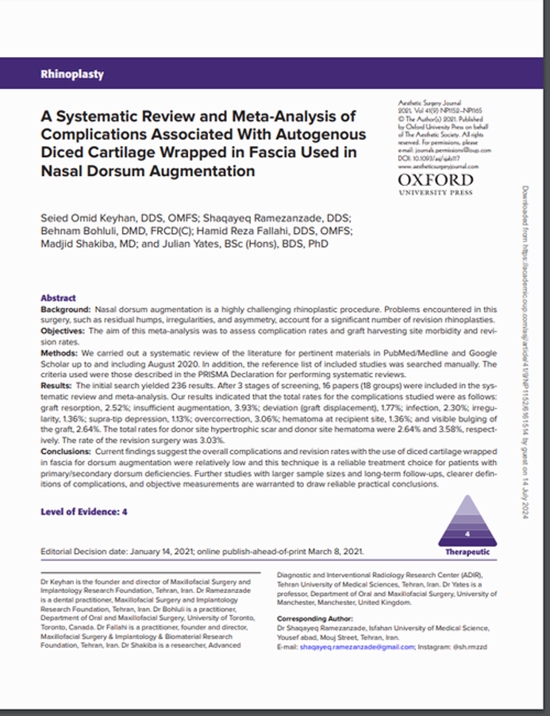
Background: Nasal dorsum augmentation is a highly challenging rhinoplastic procedure. Problems encountered in this surgery, such as residual humps, irregularities, and asymmetry, account for a significant number of revision rhinoplasties.

Objectives: The aim of this meta-analysis was to assess complication rates and graft harvesting site morbidity and revision rates.

Methods: We carried out a systematic review of the literature for pertinent materials in PubMed/Medline and Google Scholar up to and including August 2020. In addition, the reference list of included studies was searched manually. The criteria used were those described in the PRISMA Declaration for performing systematic reviews.

Results: The initial search yielded 236 results. After 3 stages of screening, 16 papers (18 groups) were included in the systematic review and meta-analysis. Our results indicated that the total rates for the complications studied were as follows: graft resorption, 2.52%; insufficient augmentation, 3.93%; deviation (graft displacement), 1.77%; infection, 2.30%; irregularity, 1.36%; supra-tip depression, 1.13%; overcorrection, 3.06%; hematoma at recipient site, 1.36%; and visible bulging of the graft, 2.64%. The total rates for donor site hypertrophic scar and donor site hematoma were 2.64% and 3.58%, respectively. The rate of the revision surgery was 3.03%.

Conclusions: Current findings suggest the overall complications and revision rates with the use of diced cartilage wrapped in fascia for dorsum augmentation were relatively low and this technique is a reliable treatment choice for patients with primary/secondary dorsum deficiencies. Further studies with larger sample sizes and long-term follow-ups, clearer definitions of complications, and objective measurements are warranted to draw reliable practical conclusions

  • Article_DOI : 10.1093/asj/sjab117
  • Author(s) : seied omid keyhan,shaqayeq ramezanzade,behnam bohluli
  • News Group : research,research article
  • News Code : 277976
مدیر سایت
Author:

مدیر سایت

Enter your desired term to search
Theme settings