Advanced Diagnostic & Interventional Radiology Research Center | Correlation of semi quantitative findings of endolymphatic hydrops in MRI with the audiometric findings in patients with Meniere’s disease
Advanced Diagnostic & Interventional Radiology Research Center | Correlation of semi quantitative findings of endolymphatic hydrops in MRI with the audiometric findings in patients with Meniere’s disease
| Dec 11 2025
logo

Advanced Diagnostic & Interventional Radiology Research Center

COVID-19 pandemic 

During the COVID-19 pandemic, the Radiology Research Center at Tehran University of Medical Sciences continued its research activities despite the challenges posed by the increased demand for CT scans of COVID-19 patients and the necessity of adhering to strict health protocols. This center played a crucial role in improving medical imaging techniques, optimizing diagnostic protocols, and advancing technologies related to CT scan image analysis.

Faculty members, researchers, and staff remained committed to ensuring the safety and well-being of healthcare professionals and patients while actively engaging in imaging data analysis, developing artificial intelligence algorithms for faster disease detection, publishing scientific articles, and presenting their findings at international conferences. These efforts aimed to enhance diagnostic accuracy, improve treatment processes, and alleviate pressure on healthcare systems.


Key achievements of the Radiology Research Center during the COVID-19 pandemic include:


✔️ Development and optimization of lung imaging protocols for faster and more accurate COVID-19 diagnosis
✔️ Implementation of artificial intelligence technologies for automated CT scan analysis and reduced diagnosis time
✔️ Publication of high-impact research articles on innovative imaging methods for COVID-19 patients
✔️ Participation in national and international projects focused on COVID-19 diagnosis and patient management

The center remains dedicated to advancing research in medical imaging and continues to contribute as a leading scientific institution in improving the quality of diagnostic and therapeutic services.


Some of the center's significant achievements during the pandemic include:


  • Release Date : Jul 21 2024 - 09:02
  • : 38
  • Study time : 1 minute(s)

Correlation of semi quantitative findings of endolymphatic hydrops in MRI with the audiometric findings in patients with Meniere’s disease

semi-quantitative findings of endolymphatic hydrops in MRI {faces}

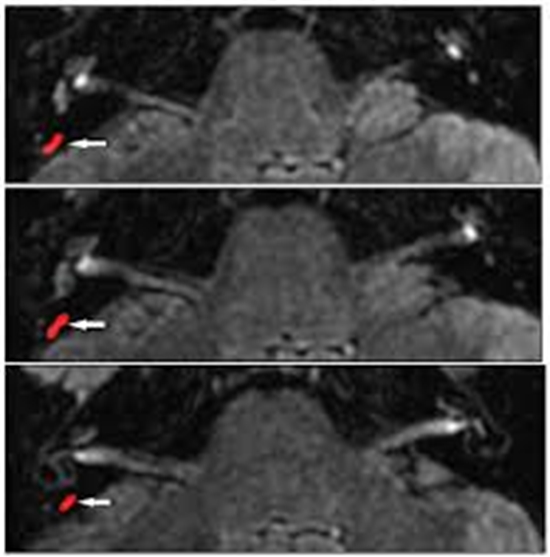
Purpose: To investigate the correlation between vestibular hydrops (VH), cochlearhydrops (CH), vestibular aqueduct non-visibility (VANV), and visually increased perilymphatic enhancement (VIPE) with the findings of pure-tone audiometry (PTA) in Meniere's disease (MD) patients. Methods: In this cross-sectional study, 53 ears belonging to 48 patients were divided into two groups and evaluated. In group "MD patients," there were 24 ears of 19 patients diagnosed with the definite MD (14 patients with unilateral and 5 patients withbilateral involvements). The "control group" consisted of 29 non-symptomatic ears belonging to patients diagnosed with unilateral sudden sensory-neural hearing loss or unilateral schwannoma. All the patients underwent 2 sessions of temporal bone MRI using the same 3T system: an unenhanced axial T1, T2, and 3D-FLAIR MRI, an intravenous gadolinium-enhanced axial T1 fat-sat, and 4 h after the injection, an axial 3D-T2 cube and 3D-FLAIR session. VH, CH, VANV, and VIPE were assessed. Subsequently, the correlation between EH indices and PTA findings (in three frequency domains of low, middle, and high) were evaluated, and the predictive value of MRI was calculated. Results: VH was significantly correlated with the hearing threshold in the low, middle, and high-frequency domains. CH was also correlated with the hearing threshold in the low and middle domains. Contrarily, VIPE was not associated with hearing thresholds, and VANV was only correlated with the hearing threshold in low frequencies. Conclusion: The grade of VH, CH, and VANV were significantly correlated with the hearing thresholds in PTA

  • Article_DOI : 10.1016/j.joto.2022.04.001
  • Author(s) : mohammad ali kazemi,ali ghasemi
  • News Group : research,research article
  • News Code : 277949
مدیر سایت
Author:

مدیر سایت

0 Comments for this article

comment

Post your comment:

متن درون تصویر را در جعبه متن زیر وارد نمائید *
Enter your desired term to search
Theme settings