Advanced Diagnostic & Interventional Radiology Research Center | Deep Learning Algorithms Accurately Segment Intracerebral Hemor

Advanced Diagnostic & Interventional Radiology Research Center | Deep Learning Algorithms Accurately Segment Intracerebral Hemor
| Dec 12 2025
logo

Advanced Diagnostic & Interventional Radiology Research Center

COVID-19 pandemic 

During the COVID-19 pandemic, the Radiology Research Center at Tehran University of Medical Sciences continued its research activities despite the challenges posed by the increased demand for CT scans of COVID-19 patients and the necessity of adhering to strict health protocols. This center played a crucial role in improving medical imaging techniques, optimizing diagnostic protocols, and advancing technologies related to CT scan image analysis.

Faculty members, researchers, and staff remained committed to ensuring the safety and well-being of healthcare professionals and patients while actively engaging in imaging data analysis, developing artificial intelligence algorithms for faster disease detection, publishing scientific articles, and presenting their findings at international conferences. These efforts aimed to enhance diagnostic accuracy, improve treatment processes, and alleviate pressure on healthcare systems.


Key achievements of the Radiology Research Center during the COVID-19 pandemic include:


✔️ Development and optimization of lung imaging protocols for faster and more accurate COVID-19 diagnosis
✔️ Implementation of artificial intelligence technologies for automated CT scan analysis and reduced diagnosis time
✔️ Publication of high-impact research articles on innovative imaging methods for COVID-19 patients
✔️ Participation in national and international projects focused on COVID-19 diagnosis and patient management

The center remains dedicated to advancing research in medical imaging and continues to contribute as a leading scientific institution in improving the quality of diagnostic and therapeutic services.


Some of the center's significant achievements during the pandemic include:


  • Release Date : Jul 15 2025 - 08:09
  • : 39
  • Study time : 1 minute(s)

Do Deep Learning Algorithms Accurately Segment Intracerebral Hemorrhages on Noncontrast Computed Tomography? A Systematic Review and Meta Analysis
 {faces}

Background

Stroke, a major global health issue, is broadly categorized into ischemic and hemorrhagic types. The volume of hemorrhage on noncontrast computed tomography guides the treatment options and hints at prognosis. Conventional approaches to calculate intracerebral hemorrhage (ICH) volume, like the ABC/2 method, typically rely on an assumed standard shape and might be inaccurate. Advances in deep learning have significantly improved noncontrast computed tomography's capabilities in ICH volume estimation. This study conducts a comprehensive systematic review and meta‐analysis to evaluate the precision of deep learning algorithms in delineating ICH on noncontrast computed tomography.

Methods

A systematic review and meta‐analysis, adhering to Preferred Reporting Items for Systematic Reviews and Meta‐Analyses guidelines, was conducted on literature from 2000 to October 2023. Studies were selected on the basis of strict inclusion and exclusion criteria. Performance evaluation was done using the Dice Similarity Coefficient, and the Prediction Model Risk of Bias Assessment Tool was used for quality assessment. Statistical analysis was carried out using Stata 17.0.

Results

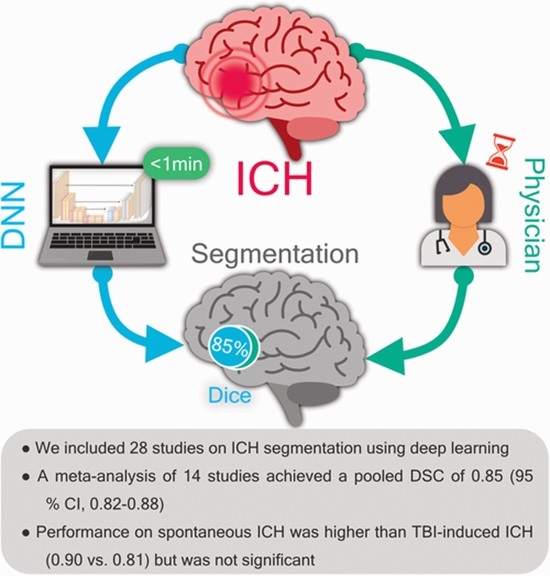
The review included 28 studies, mainly retrospective cohorts, with a focus on convolutional neural network architectures, particularly U‐Net variants. A meta‐analysis of 14 studies revealed a combined Dice Similarity Coefficient of 0.85 (95% CI, 0.82–0.88). Performance was consistent across various methodologies but varied on the basis of ICH pathogenesis, with spontaneous ICH having higher accuracy.

Conclusion

Deep learning models are highly effective in segmenting ICH on noncontrast computed tomography, demonstrating potential improvements in clinical neuroimaging. Despite their efficacy, challenges in segmenting smaller hemorrhages remain. The findings suggest that deep learning could reduce health care professional workloads and enhance patient care, although further research is needed to address limitations and extend clinical utility.
  • Article_DOI : doi.org/10.1161/SVIN.123.00131
  • Author(s) : diana zarei ,david s
  • News Group : research,research article,AI
  • News Code : 300944
نفیسه سادات قوامی
Author:

نفیسه سادات قوامی

0 Comments for this article

comment

Post your comment:

متن درون تصویر را در جعبه متن زیر وارد نمائید *
Enter your desired term to search
Theme settings