Advanced Diagnostic & Interventional Radiology Research Center | Patient-Specific Hemodynamic Simulation for Predicting Cardiac S

Advanced Diagnostic & Interventional Radiology Research Center | Patient-Specific Hemodynamic Simulation for Predicting Cardiac S
| Aug 3 2026
logo

Advanced Diagnostic & Interventional Radiology Research Center

COVID-19 pandemic 

During the COVID-19 pandemic, the Radiology Research Center at Tehran University of Medical Sciences continued its research activities despite the challenges posed by the increased demand for CT scans of COVID-19 patients and the necessity of adhering to strict health protocols. This center played a crucial role in improving medical imaging techniques, optimizing diagnostic protocols, and advancing technologies related to CT scan image analysis.

Faculty members, researchers, and staff remained committed to ensuring the safety and well-being of healthcare professionals and patients while actively engaging in imaging data analysis, developing artificial intelligence algorithms for faster disease detection, publishing scientific articles, and presenting their findings at international conferences. These efforts aimed to enhance diagnostic accuracy, improve treatment processes, and alleviate pressure on healthcare systems.


Key achievements of the Radiology Research Center during the COVID-19 pandemic include:


✔️ Development and optimization of lung imaging protocols for faster and more accurate COVID-19 diagnosis
✔️ Implementation of artificial intelligence technologies for automated CT scan analysis and reduced diagnosis time
✔️ Publication of high-impact research articles on innovative imaging methods for COVID-19 patients
✔️ Participation in national and international projects focused on COVID-19 diagnosis and patient management

The center remains dedicated to advancing research in medical imaging and continues to contribute as a leading scientific institution in improving the quality of diagnostic and therapeutic services.


Some of the center's significant achievements during the pandemic include:


  • Release Date : Jun 20 2026 - 09:46
  • : 13
  • Study time : 1 minute(s)

Patient-Specific Hemodynamic Simulation for Predicting Stroke Laterality in Cardiac Embolism
Patient-Specific Hemodynamic Simulation for Predicting Cardiac Stroke   {faces}

Background and Purpose

Cardioembolic sources account for 20%–30% of acute ischemic strokes (AIS), often with high morbidity. Conventional imaging confirms etiology retrospectively but lacks insight into the dynamic behavior of embolic transport. We aimed to predict stroke laterality by integrating patient-specific computational fluid dynamics (CFD) simulations with robust Bayesian logistic regression modeling.

Methods

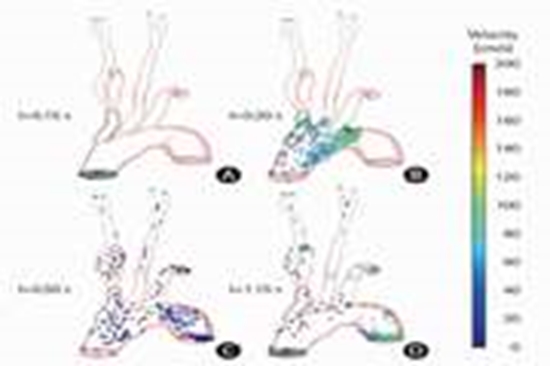
Eight patients (median age 77.5 years; 2 females) with anterior circulation AIS of confirmed cardiac origin underwent high-resolution computed tomography angiography. Vascular geometries were segmented to generate CFD models simulating physiologic pulsatile flow. In each cardiac cycle, 1,000 massless particles were released at the aortic inlet. Two features were derived: x1 (long-term embolic bias over 10 seconds) and x2 (short-term embolic bias during the first cardiac cycle). These were used as predictors in a robust Bayesian logistic regression model.

Results

The right internal carotid artery (ICA) received more embolic particles (mean 34/s) than the left ICA (mean 28/s). Patients with right-sided strokes had higher x1 (median 0.27 vs. -0.44) and lower x2 (median -0.82 vs. 0.56) than those with left-sided strokes. The model yielded posterior mean coefficients of 1.51 (95% credible interval [CrI]: -0.46 to 4.11) for x1 and -1.96 (95% CrI: -4.88 to 0.20) for x2, achieving complete separation of stroke patients by laterality in this pilot cohort.

Conclusions

The combination of CFD-based embolic modeling and Bayesian analysis accurately predicted stroke laterality in cardioembolic AIS, exposing distinct patient-specific embolic transport dynamics.

  • Article_DOI : 10.5853/jos.2025.01571
  • Author(s) : mahbod issaiy,pouria moshayedi
  • News Group : research,research article
  • News Code : 323920
نفیسه سادات قوامی
Author:

نفیسه سادات قوامی

0 Comments for this article

comment

Post your comment:

متن درون تصویر را در جعبه متن زیر وارد نمائید *
Enter your desired term to search
Theme settings