Advanced Diagnostic & Interventional Radiology Research Center | Proposed Imaging Guideline for Pregnant Women Suspected of covid

Advanced Diagnostic & Interventional Radiology Research Center | Proposed Imaging Guideline for Pregnant Women Suspected of covid
| Dec 12 2025
logo

Advanced Diagnostic & Interventional Radiology Research Center

COVID-19 pandemic 

During the COVID-19 pandemic, the Radiology Research Center at Tehran University of Medical Sciences continued its research activities despite the challenges posed by the increased demand for CT scans of COVID-19 patients and the necessity of adhering to strict health protocols. This center played a crucial role in improving medical imaging techniques, optimizing diagnostic protocols, and advancing technologies related to CT scan image analysis.

Faculty members, researchers, and staff remained committed to ensuring the safety and well-being of healthcare professionals and patients while actively engaging in imaging data analysis, developing artificial intelligence algorithms for faster disease detection, publishing scientific articles, and presenting their findings at international conferences. These efforts aimed to enhance diagnostic accuracy, improve treatment processes, and alleviate pressure on healthcare systems.


Key achievements of the Radiology Research Center during the COVID-19 pandemic include:


✔️ Development and optimization of lung imaging protocols for faster and more accurate COVID-19 diagnosis
✔️ Implementation of artificial intelligence technologies for automated CT scan analysis and reduced diagnosis time
✔️ Publication of high-impact research articles on innovative imaging methods for COVID-19 patients
✔️ Participation in national and international projects focused on COVID-19 diagnosis and patient management

The center remains dedicated to advancing research in medical imaging and continues to contribute as a leading scientific institution in improving the quality of diagnostic and therapeutic services.


Some of the center's significant achievements during the pandemic include:


  • Release Date : Jun 24 2024 - 08:04
  • : 27
  • Study time : 1 minute(s)

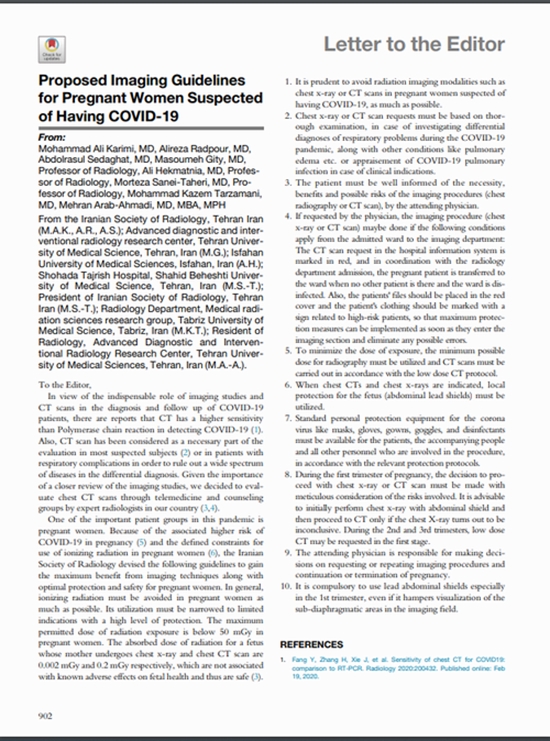
Proposed Imaging Guidelines for Pregnant Women Suspected of Having COVID-19
Pregnant Women Suspected of Having COVID-19 {faces}

In view of the indispensable role of imaging studies and CT scans in the diagnosis and follow up of COVID-19 patients, there are reports that CT has a higher sensitivity than Polymerase chain reaction in detecting COVID-19 (). Also, CT scan has been considered as a necessary part of the evaluation in most suspected subjects () or in patients with respiratory complications in order to rule out a wide spectrum of diseases in the differential diagnosis. Given the importance of a closer review of the imaging studies, we decided to evaluate chest CT scans through telemedicine and counseling groups by expert radiologists in our country (,).

One of the important patient groups in this pandemic is pregnant women. Because of the associated higher risk of COVID-19 in pregnancy () and the defined constraints for use of ionizing radiation in pregnant women (), the Iranian Society of Radiology devised the following guidelines to gain the maximum benefit from imaging techniques along with optimal protection and safety for pregnant women. In general, ionizing radiation must be avoided in pregnant women as much as possible. Its utilization must be narrowed to limited indications with a high level of protection. The maximum permitted dose of radiation exposure is below 50 mGy in pregnant women. The absorbed dose of radiation for a fetus whose mother undergoes chest x-ray and chest CT scan are 0.002 mGy and 0.2 mGy respectively, which are not associated with known adverse effects on fetal health and thus are safe ().

  • Article_DOI : 10.1016/j.acra.2020.04.018
  • Author(s) : mohammad ali karimi, morteza sanei-taheri
  • News Group : research,research article,covid 19
  • News Code : 278277
مدیر سایت
Author:

مدیر سایت

Enter your desired term to search
Theme settings