Advanced Diagnostic & Interventional Radiology Research Center | Risk scores for prediction of paroxysmal atrial fibrillation after acute ischemic stroke or transient ischemic attack: A systematic review and meta analysis
Advanced Diagnostic & Interventional Radiology Research Center | Risk scores for prediction of paroxysmal atrial fibrillation after acute ischemic stroke or transient ischemic attack: A systematic review and meta analysis
| Dec 12 2025
logo

Advanced Diagnostic & Interventional Radiology Research Center

COVID-19 pandemic 

During the COVID-19 pandemic, the Radiology Research Center at Tehran University of Medical Sciences continued its research activities despite the challenges posed by the increased demand for CT scans of COVID-19 patients and the necessity of adhering to strict health protocols. This center played a crucial role in improving medical imaging techniques, optimizing diagnostic protocols, and advancing technologies related to CT scan image analysis.

Faculty members, researchers, and staff remained committed to ensuring the safety and well-being of healthcare professionals and patients while actively engaging in imaging data analysis, developing artificial intelligence algorithms for faster disease detection, publishing scientific articles, and presenting their findings at international conferences. These efforts aimed to enhance diagnostic accuracy, improve treatment processes, and alleviate pressure on healthcare systems.


Key achievements of the Radiology Research Center during the COVID-19 pandemic include:


✔️ Development and optimization of lung imaging protocols for faster and more accurate COVID-19 diagnosis
✔️ Implementation of artificial intelligence technologies for automated CT scan analysis and reduced diagnosis time
✔️ Publication of high-impact research articles on innovative imaging methods for COVID-19 patients
✔️ Participation in national and international projects focused on COVID-19 diagnosis and patient management

The center remains dedicated to advancing research in medical imaging and continues to contribute as a leading scientific institution in improving the quality of diagnostic and therapeutic services.


Some of the center's significant achievements during the pandemic include:


  • Release Date : Sep 23 2024 - 14:23
  • : 152
  • Study time : 1 minute(s)

Risk scores for prediction of paroxysmal atrial fibrillation after acute ischemic stroke or transient ischemic attack: A systematic review and meta analysis

 {faces}

Introduction: Detection of paroxysmal atrial fibrillation (PAF) is crucial for secondary prevention in patients with recent strokes of unknown etiology. This systematic review and meta-analysis assess the predictive power of available risk scores for detecting new PAF after acute ischemic stroke (AIS).

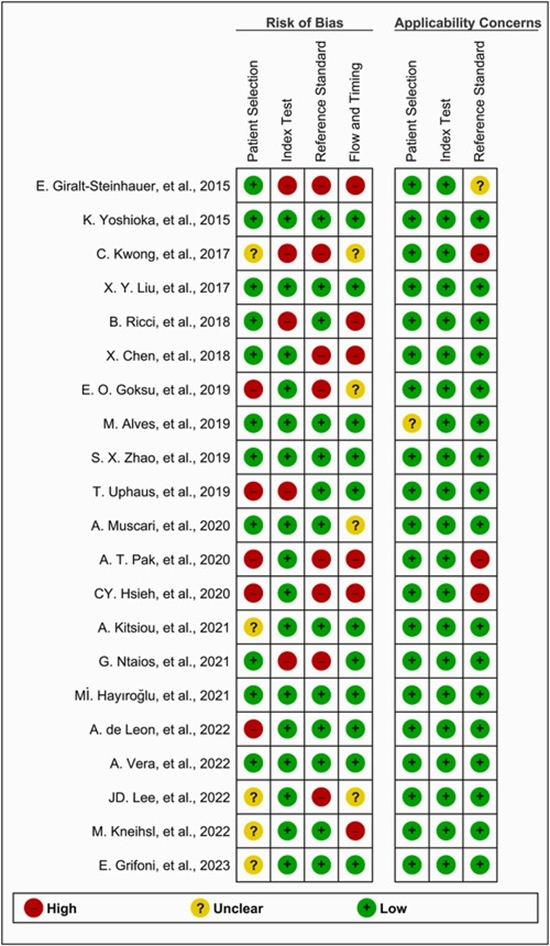
Methods: PubMed, Embase, Scopus, and Web of Science databases were searched until September 2023 to identify relevant studies. A bivariate random effects meta-analysis model pooled data on sensitivity, specificity, and area under the curve (AUC) for each score. The QUADAS-2 tool was used for the quality assessment.

Results: Eventually, 21 studies with 18 original risk scores were identified. Age, left atrial enlargement, and NIHSS score were the most common predictive factors, respectively. Seven risk scores were meta-analyzed, with iPAB showing the highest pooled sensitivity and AUC (sensitivity: 89.4%, specificity: 74.2%, AUC: 0.83), and HAVOC having the highest pooled specificity (sensitivity: 46.3%, specificity: 82.0%, AUC: 0.82). Altogether, seven risk scores displayed good discriminatory power (AUC ≥0.80) with four of them (HAVOC, iPAB, Fujii, and MVP scores) being externally validated.

Conclusion: Available risk scores demonstrate moderate to good predictive accuracy and can help identify patients who would benefit from extended cardiac monitoring after AIS. External validation is essential before widespread clinical adoption.

Keywords: Acute ischemic stroke; Cryptogenic stroke; Paroxysmal atrial fibrillation; Risk score; Risk stratification.


link

  • Article_DOI : 10.1016/j.ijcrp.2024.200249
  • Author(s) : sina kazemian,diana zarei , ali bozorgi,saman nazarian ,mahbod issaiy
  • News Group : research,articles,research article,AI,AI articles
  • News Code : 278862
نفیسه سادات قوامی
Author:

نفیسه سادات قوامی

0 Comments for this article

comment

Post your comment:

متن درون تصویر را در جعبه متن زیر وارد نمائید *
Enter your desired term to search
Theme settings