


Subnational mapping of HIV incidence and mortality among individuals aged 15/49 years in sub Saharan Africa, 2000/18: a modelling study
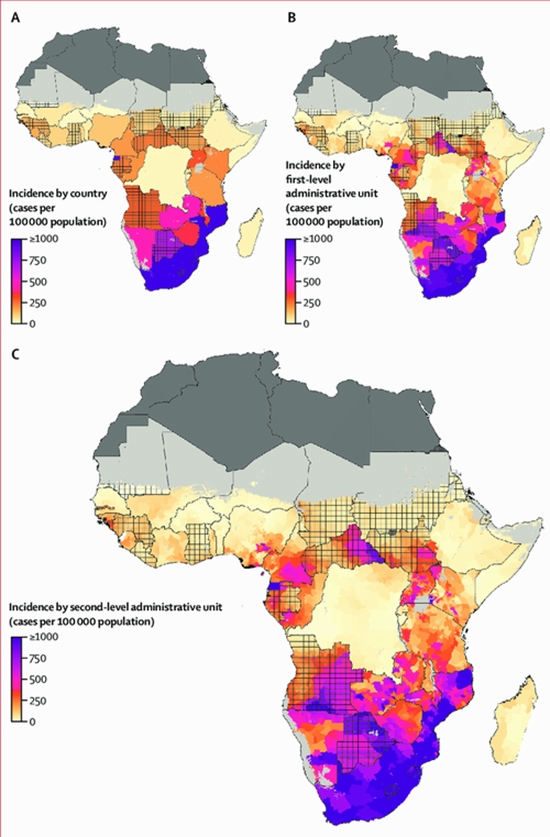
Background: High-resolution estimates of HIV burden across space and time provide an important tool for tracking and monitoring the progress of prevention and control efforts and assist with improving the precision and efficiency of targeting efforts. We aimed to assess HIV incidence and HIV mortality for all second-level administrative units across sub-Saharan Africa.
Methods: In this modelling study, we developed a framework that used the geographically specific HIV prevalence data collected in seroprevalence surveys and antenatal care clinics to train a model that estimates HIV incidence and mortality among individuals aged 15-49 years. We used a model-based geostatistical framework to estimate HIV prevalence at the second administrative level in 44 countries in sub-Saharan Africa for 2000-18 and sought data on the number of individuals on antiretroviral therapy (ART) by second-level administrative unit. We then modified the Estimation and Projection Package (EPP) to use these HIV prevalence and treatment estimates to estimate HIV incidence and mortality by second-level administrative unit.
Findings: The estimates suggest substantial variation in HIV incidence and mortality rates both between and within countries in sub-Saharan Africa, with 15 countries having a ten-times or greater difference in estimated HIV incidence between the second-level administrative units with the lowest and highest estimated incidence levels. Across all 44 countries in 2018, HIV incidence ranged from 2·8 (95% uncertainty interval 2·1-3·8) in Mauritania to 1585·9 (1369·4-1824·8) cases per 100 000 people in Lesotho and HIV mortality ranged from 0·8 (0·7-0·9) in Mauritania to 676·5 (513·6-888·0) deaths per 100 000 people in Lesotho. Variation in both incidence and mortality was substantially greater at the subnational level than at the national level and the highest estimated rates were accordingly higher. Among second-level administrative units, Guijá District, Gaza Province, Mozambique, had the highest estimated HIV incidence (4661·7 [2544·8-8120·3]) cases per 100 000 people in 2018 and Inhassunge District, Zambezia Province, Mozambique, had the highest estimated HIV mortality rate (1163·0 [679·0-1866·8]) deaths per 100 000 people. Further, the rate of reduction in HIV incidence and mortality from 2000 to 2018, as well as the ratio of new infections to the number of people living with HIV was highly variable. Although most second-level administrative units had declines in the number of new cases (3316 [81·1%] of 4087 units) and number of deaths (3325 [81·4%]), nearly all appeared well short of the targeted 75% reduction in new cases and deaths between 2010 and 2020.
Interpretation: Our estimates suggest that most second-level administrative units in sub-Saharan Africa are falling short of the targeted 75% reduction in new cases and deaths by 2020, which is further compounded by substantial within-country variability. These estimates will help decision makers and programme implementers expand access to ART and better target health resources to higher burden subnational areas.
Funding: Bill & Melinda Gates Foundation


Send to friends