Advanced Diagnostic & Interventional Radiology Research Center | Tractography-based Predictors of Post-Stroke Aphasia

Advanced Diagnostic & Interventional Radiology Research Center | Tractography-based Predictors of Post-Stroke Aphasia
| Aug 4 2026
logo

Advanced Diagnostic & Interventional Radiology Research Center

COVID-19 pandemic 

During the COVID-19 pandemic, the Radiology Research Center at Tehran University of Medical Sciences continued its research activities despite the challenges posed by the increased demand for CT scans of COVID-19 patients and the necessity of adhering to strict health protocols. This center played a crucial role in improving medical imaging techniques, optimizing diagnostic protocols, and advancing technologies related to CT scan image analysis.

Faculty members, researchers, and staff remained committed to ensuring the safety and well-being of healthcare professionals and patients while actively engaging in imaging data analysis, developing artificial intelligence algorithms for faster disease detection, publishing scientific articles, and presenting their findings at international conferences. These efforts aimed to enhance diagnostic accuracy, improve treatment processes, and alleviate pressure on healthcare systems.


Key achievements of the Radiology Research Center during the COVID-19 pandemic include:


✔️ Development and optimization of lung imaging protocols for faster and more accurate COVID-19 diagnosis
✔️ Implementation of artificial intelligence technologies for automated CT scan analysis and reduced diagnosis time
✔️ Publication of high-impact research articles on innovative imaging methods for COVID-19 patients
✔️ Participation in national and international projects focused on COVID-19 diagnosis and patient management

The center remains dedicated to advancing research in medical imaging and continues to contribute as a leading scientific institution in improving the quality of diagnostic and therapeutic services.


Some of the center's significant achievements during the pandemic include:


  • Release Date : Jun 17 2026 - 12:17
  • : 20
  • Study time : 1 minute(s)

Tractography-based Predictors of Post-Stroke Aphasia: A Systematic Review
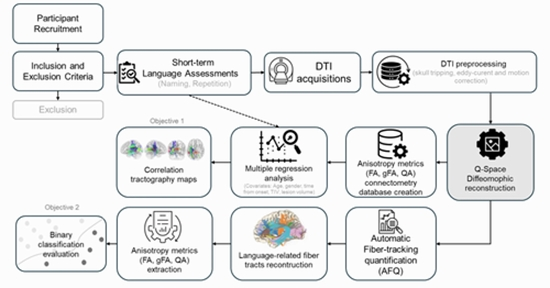
Tractography-based Predictors of Post-Stroke Aphasia {faces}

BACKGROUND: Post-stroke aphasia is a common and disabling consequence of ischemic stroke, substantially affecting communication and quality of life. Early identification of patients at risk is essential for prognosis and rehabilitation planning. Diffusion tractography has recently been employed to map white matter pathways implicated in language processing and to evaluate their predictive value for post-stroke aphasia.

PURPOSE: In this study we aimed to evaluate the prognostic value of diffusion tensor imaging characteristics of key white matter tracts.

DATA SOURCES: A systematic search was conducted in PubMed, Embase, and Scopus until April 2025.

STUDY SELECTION: Eligible studies applied diffusion MRI tractography to assess structural language pathways in patients with stroke and investigated their association with post-stroke aphasia occurrence or severity.

DATA ANALYSIS: Extracted data included study characteristics, tractography methodology, language assessment tools, and key imaging findings, including tract-specific diffusion metrics and tractography-derived measures. Due to data insufficiency, qualitative synthesis was conducted.

DATA SYNTHESIS: Twenty-one studies comprising 550 patients with post-stroke aphasia were included. Participants were predominantly older adults, with mean/median ages generally in the late 50s to early 70s. Baseline NIHSS values were commonly in the ∼5–14 range. The timing of diffusion/DTI acquisition varied substantially, spanning hyperacute/acute imaging, early subacute assessments, and later evaluations in the chronic phase. Studies identified left arcuate fasciculus (AF) integrity, fractional anisotropy (FA), axial diffusivity (AD), or reconstruction status, as the strongest single predictor of aphasia severity and recovery. Loss of AF reconstruction was associated with markedly lower follow-up AQ. Ventral-stream involvement added prognostic value in several studies. Right-hemisphere contributions were inconsistent, though higher callosal anisotropy predicted comprehension gains in one cohort. Overall, tract-specific microstructure improved prognostic models beyond lesion volume or NIHSS, accounting for an additional 12–29% of outcome variance in several multivariate analyses.

  • Article_DOI : https://doi.org/10.3174/ajnr.A9333
  • Author(s) : mahshad narimani
  • News Group : research,research article
  • News Code : 323801
نفیسه سادات قوامی
Author:

نفیسه سادات قوامی

0 Comments for this article

comment

Post your comment:

متن درون تصویر را در جعبه متن زیر وارد نمائید *
Enter your desired term to search
Theme settings