

Resting-state cardiac magnetic resonance perfusion imaging accuracy in diagnosing patients with coronary artery disease: A comparison with percutaneous coronary intervention
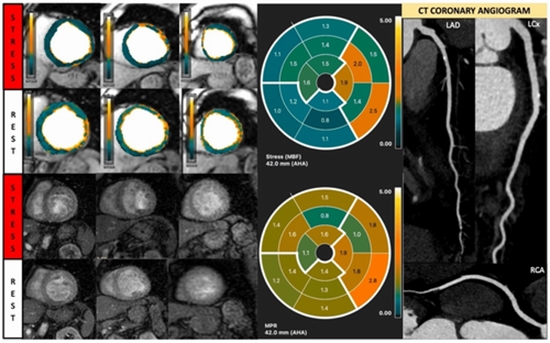
Background: Myocardial ischemia may occur as a result of a variety of vascular and congenital conditions. There are different methods to assess ischemic myocardial tissue
This study aimed to assess the diagnostic accuracy of cardiac magnetic resonance imaging (CMR) in advanced coronary artery disease (CAD).
Methods: Thirty patients with a predefined history of severe CAD underwent CMR with a 1.5 T CMR machine. The imaging protocol consisted of 4 steps: left ventricular functional imaging, T1-weighted contrast-enhanced magnetic resonance perfusion imaging, early gadolinium enhancement, and delayed gadolinium enhancement. The left ventricular functional indices and time-intensity curves (TICs) of the magnetic resonance perfusion imaging were calculated using a CMR analysis software tool. The TICs were drawn on 90 normal, early, and delayed gadolinium-enhanced territories under the guidance of percutaneous coronary angiography reports.
Results: Overall, 90 territories were derived from the 30 patients. Fifty-two territories were diagnosed with significant CAD and 38 with a normal coronary status. Our analysis revealed 35 regions with flattened TICs (increased time to peak, deceased maximum intensity, and more time-lasting plateaus) and 17 with normal patterns in diseased territories. From the total 38 angiographically normal regions, 36 regions presented normal TICs and 2 showed diseased patterns. The diagnostic accuracy, sensitivity, specificity, positive predictive value, and negative predictive value of CMR were 78.8%, 67.3%, 94.7%, 94.59%, and 67.92%, respectively, in comparison with percutaneous coronary angiography.
Conclusions: Resting-state CMR can be used to detect the presence of any severe/significant coronary artery lesion with an acceptable accuracy


Send to friends