

The role of FOXC1/FOXCUT/DANCR axis in triple negative breast cancer: a bioinformatics and experimental approach
Background: Triple-negative breast cancer (TNBC) is the most challenging subtype of breast cancer and does not benefit from the existing targeted therapies. In the present study, we used bioinformatics and experimental approaches to assess the genes that are somehow involved in the epithelial-mesenchymal transition (EMT) pathway which may explain the invasive features of TNBC.
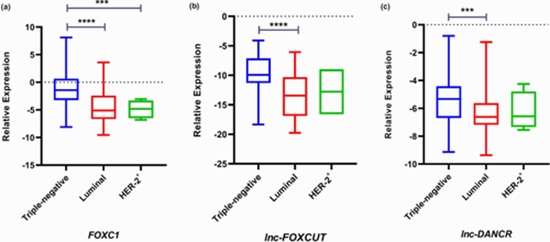
Method and results: We analyzed five GEO datasets consisting of 657 breast tumors by GEO2R online software to achieve common differentially expressed genes (DEGs) between TNBC and non-TNBC tumors. The expression of the selected coding and non-coding genes was validated in 100 breast tumors, including fifty TNBC and fifty non-TNBC samples, using quantitative Real-Time PCR (qRT-PCR). The bioinformatics approach resulted in a final DEG list consisting of ten upregulated and seventeen downregulated genes (logFC ≥|1| and P < 0.05). Co-expression network construction indicated the FOXC1 transcription factor as a central hub node. Considering the notable role of FOXC1 in EMT, the expression levels of FOXC1-related lncRNAs, lnc-FOXCUT and lnc-DANCR, were also evaluated in the studied tumors. The results of qRT-PCR confirmed notable upregulation of FOXC1, lnc-FOXCUT, and lnc-DANCR in TNBC tissues compared to non-TNBC samples (P < 0.0001, P = 0.0005, and P = 0.0008, respectively). Moreover, ROC curve analysis revealed the potential biomarker role of FOXC1 in TNBC samples.
Conclusion: Present study suggested that the deregulation of FOXC1/lnc-FOXCUT/lnc-DANCR axis may contribute to the aggressive features of triple-negative breast tumors. Therefore, this axis may be considered as a new probable therapeutic target in the treatment of TNBC.
Keywords: Bioinformatics; FOXC1; Lnc-DANCR; Lnc-FOXCUT; Triple-negative breast cancer.


comment