


Effects of Variations of Flow and Heart Rate on Intra-Aneurysmal Hemodynamics in a Ruptured Internal Carotid Artery Aneurysm During Exercise
This study aimed to investigate the effects of variations in heart rate and internal carotid artery (ICA) flow rate on intra-aneurysmal hemodynamics, in an ICA aneurysm, by using computational fluid dynamics
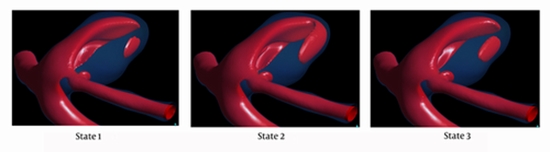
Background: Hemodynamics is thought to play an important role in the mechanisms responsible for initiation, growth, and rupture of intracranial aneurysms. Computational fluid dynamic (CFD) analysis is used to assess intra-aneurysmal hemodynamics.
Objectives: This study aimed to investigate the effects of variations in heart rate and internal carotid artery (ICA) flow rate on intra-aneurysmal hemodynamics, in an ICA aneurysm, by using computational fluid dynamics.
Patients and methods: Computed tomography angiography (CTA) was performed in a 55 years old female case, with a saccular ICA aneurysm, to create a patient-specific geometrical anatomic model of the aneurysm. The intra-aneurysmal hemodynamic environments for three states with different flow and heart rates were analyzed using patient-specific image-based CFD modeling.
Results: Results showed significant changes for the three simulated states. For a proportion of the states examined, results were counterintuitive. Systolic and time-averaged wall shear stress and pressure on the aneurysm wall showed a proportional evolution with the mainstream flow rate.
Conclusion: Results reinforced the pivotal role of vascular geometry, with respect to hemodynamics, together with the importance of performing patient-specific CFD analyses, through which the effect of different blood flow conditions on the aneurysm hemodynamics could be evaluated.


Send to friends