Advanced Diagnostic & Interventional Radiology Research Center | A systematic review and meta analysis on the association between lymphocyte subsets and the severity of COVID 19
Advanced Diagnostic & Interventional Radiology Research Center | A systematic review and meta analysis on the association between lymphocyte subsets and the severity of COVID 19
| Feb 4 2026
logo

Advanced Diagnostic & Interventional Radiology Research Center

COVID-19 pandemic 

During the COVID-19 pandemic, the Radiology Research Center at Tehran University of Medical Sciences continued its research activities despite the challenges posed by the increased demand for CT scans of COVID-19 patients and the necessity of adhering to strict health protocols. This center played a crucial role in improving medical imaging techniques, optimizing diagnostic protocols, and advancing technologies related to CT scan image analysis.

Faculty members, researchers, and staff remained committed to ensuring the safety and well-being of healthcare professionals and patients while actively engaging in imaging data analysis, developing artificial intelligence algorithms for faster disease detection, publishing scientific articles, and presenting their findings at international conferences. These efforts aimed to enhance diagnostic accuracy, improve treatment processes, and alleviate pressure on healthcare systems.


Key achievements of the Radiology Research Center during the COVID-19 pandemic include:


✔️ Development and optimization of lung imaging protocols for faster and more accurate COVID-19 diagnosis
✔️ Implementation of artificial intelligence technologies for automated CT scan analysis and reduced diagnosis time
✔️ Publication of high-impact research articles on innovative imaging methods for COVID-19 patients
✔️ Participation in national and international projects focused on COVID-19 diagnosis and patient management

The center remains dedicated to advancing research in medical imaging and continues to contribute as a leading scientific institution in improving the quality of diagnostic and therapeutic services.


Some of the center's significant achievements during the pandemic include:


  • Release Date : Jul 23 2024 - 08:38
  • : 143
  • Study time : 1 minute(s)

A systematic review and meta analysis on the association between lymphocyte subsets and the severity of COVID 19

association between lymphocyte subsets and the severity of COVID 19 {faces}

Introduction: Prominent prognostic parameters that reflect the severity of coronavirus disease 2019 (COVID-19) to adopt an appropriate therapeutic approach are not fully identified. This systematic review and meta-analysis aimed to explore the association between lymphocyte variation and disease severity in COVID-19 individuals.

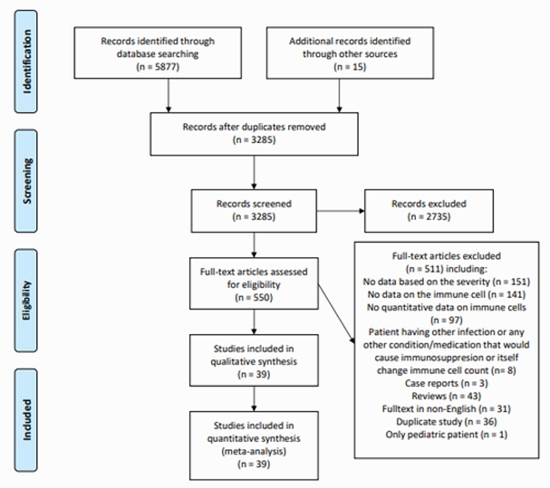
Methods: We searched Web of Science, Scopus, PubMed, EMBASE and WHO website to retrieve studies investigating lymphocyte subset counts in non-severe and severe cases of COVID-19. The pooled standardized mean difference (SMD) between two groups and the pooled average count of each lymphocyte subset were assessed by employing a random-effect model.

Results: Thirty-nine investigations on 5087 participants, including 3578 non-severe patients and 1509 severe patients, were included. The pooled analysis showed that non-severe patients had higher total T lymphocytes (SMD = 1.01; 95% CI: 0.82, 1.20; I2 = 75.7%), T helper cells (SMD = 1.07; 95% CI: 0.85, 1.28; I2 = 85.4%), T cytotoxic cells (SMD = 1.07; 95% CI: 0.82, 1.32; I2 = 87.1%), B cells (SMD = 0.72; 95% CI: 0.45, 0.98; I2 = 79.7%), and natural killer cells (SMD = 0.65; 95% CI: 0.47, 0.84; I2 = 63.1%) than severe patients and the average count of the corresponding lymphocyte signatures in non-severe patients/severe patients were 878.88/448.40, 493.12/268.96, 311.91/158.91, 177.09/110.37, and 155.02/103.09 cells/μL, respectively.

Conclusion: Lymphopenia may be a dilemma in COVID-19 management because over-activation of lymphocytes may lead to cytokine storm or acute respiratory distress syndrome (ARDS). In contrast, lymphopenia may increase SARS-CoV-2 amplification and COVID-19 severity. Therefore, novel therapies targeting lymphocyte proliferation or contraction may counterbalance lymphocyte counts in these patients.

  • Article_DOI : 10.34172/ipp.2022.29303
  • Author(s) : hojat dehghanbanadaki , hossein aazami
  • News Group : research,research article,covid 19,covid
  • News Code : 277943
مدیر سایت
Author:

مدیر سایت

0 Comments for this article

comment

Post your comment:

متن درون تصویر را در جعبه متن زیر وارد نمائید *
Enter your desired term to search
Theme settings