


ADC-derived spatial features can accurately classify adnexal lesions
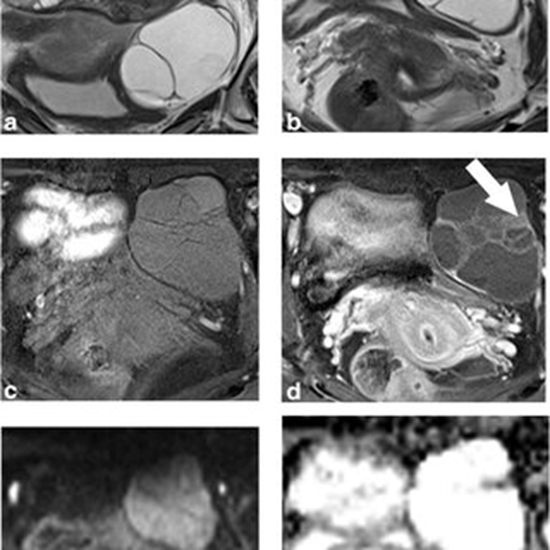
Background: The role of quantitative apparent diffusion coefficient (ADC) maps in differentiating adnexal masses is unresolved
Purpose/hypothesis: To propose an objective diagnostic method devised based on spatial features for predicting benignity/malignancy of adnexal masses in ADC maps
Study type: Prospective
Population: In all, 70 women with sonographically indeterminate and histopathologically confirmed adnexal masses (38 benign, 3 borderline, and 29 malignant) were considered for this study
Field strength/sequence: Conventional and diffusion-weighted magnetic resonance (MR) images (b-values = 50, 400, 1000 s/mm2 ) were acquired on a 3T scannerAssessment: For each patient, two radiologists in consensus manually delineated lesion borders in whole ADC map volumes, which were consequently analyzed using spatial models (first-order histogram [FOH], gray-level co-occurrence matrix [GLCM], run-length matrix [RLM], and Gabor filters). Two independent radiologists were asked to identify the attributed (benign/malignant) classes of adnexal masses based on morphological features on conventional MRI.
Statistical tests: Leave-one-out cross-validated feature selection followed by cross-validated classification were applied to the feature space to choose the spatial models that best discriminate benign from malignant adnexal lesions. Two schemes of feature selection/classification were evaluated: 1) including all benign and malignant masses, and 2) scheme 1 after excluding endometrioma, hemorrhagic cysts, and teratoma (14 benign, 29 malignant masses). The constructed feature subspaces for benign/malignant lesion differentiation were tested for classification of benign/borderline/malignant and also borderline/malignant adnexal lesions.
Results: The selected feature subspace consisting of RLM features differentiated benign from malignant adnexal masses with a classification accuracy of ∼92%. The same model discriminated benign, borderline, and malignant lesions with 87% and borderline from malignant with 100% accuracy. Qualitative assessment of the radiologists based on conventional MRI features reached an accuracy of 80%.
Data conclusion: The spatial quantification methodology proposed in this study, which works based on cellular distributions within ADC maps of adnexal masses, may provide a helpful computer-aided strategy for objective characterization of adnexal masses.


Send to friends