Advanced Diagnostic & Interventional Radiology Research Center | Ultrasound Measures with POP-Q in Patients with Pelvic Organ Pr

Advanced Diagnostic & Interventional Radiology Research Center | Ultrasound Measures with POP-Q in Patients with Pelvic Organ Pr
| Dec 12 2025
logo

Advanced Diagnostic & Interventional Radiology Research Center

COVID-19 pandemic 

During the COVID-19 pandemic, the Radiology Research Center at Tehran University of Medical Sciences continued its research activities despite the challenges posed by the increased demand for CT scans of COVID-19 patients and the necessity of adhering to strict health protocols. This center played a crucial role in improving medical imaging techniques, optimizing diagnostic protocols, and advancing technologies related to CT scan image analysis.

Faculty members, researchers, and staff remained committed to ensuring the safety and well-being of healthcare professionals and patients while actively engaging in imaging data analysis, developing artificial intelligence algorithms for faster disease detection, publishing scientific articles, and presenting their findings at international conferences. These efforts aimed to enhance diagnostic accuracy, improve treatment processes, and alleviate pressure on healthcare systems.


Key achievements of the Radiology Research Center during the COVID-19 pandemic include:


✔️ Development and optimization of lung imaging protocols for faster and more accurate COVID-19 diagnosis
✔️ Implementation of artificial intelligence technologies for automated CT scan analysis and reduced diagnosis time
✔️ Publication of high-impact research articles on innovative imaging methods for COVID-19 patients
✔️ Participation in national and international projects focused on COVID-19 diagnosis and patient management

The center remains dedicated to advancing research in medical imaging and continues to contribute as a leading scientific institution in improving the quality of diagnostic and therapeutic services.


Some of the center's significant achievements during the pandemic include:


  • Release Date : Apr 17 2024 - 08:58
  • : 7
  • Study time : 1 minute(s)

Agreement of Ultrasound Measures with POP-Q in Patients with Pelvic Organ Prolapse
Ultrasound Measures with POP-Q in Pelvic Organ Prolapse {faces}

Background:

Ultrasound has emerged as a valuable complimentary tool for assessment of pelvic organ prolapse (POP).

Objectives:

The present study aimed to evaluate the correlation between ultrasound measures and clinical staging in patients with suspected POP.

Patients and Methods:

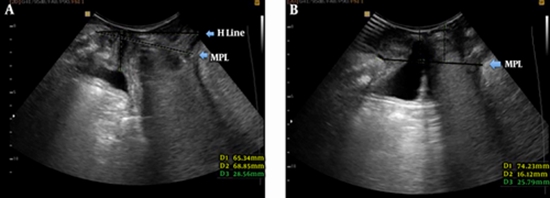
Forty women with clinical suspicion of POP were enrolled in this cross-sectional study between November 2011 and April 2012. Pelvic organ prolapse quantification (POP-Q) system was used for clinical staging. Perineal ultrasound was performed both at rest and during Valsalva maneuver after proper preparation. On mid sagittal view, two reference lines were drawn; midpelvic line (MPL) was defined as the inferior horizontal tangent of symphysis pubis and H line was drawn from the most inferior part of symphysis pubis to the anorectal junction. Spearman’s correlation coefficient and Kappa coefficient of agreements were used for statistical analysis.

Results:

Forty women with the mean age of 49.9 ± 10.07 years were enrolled. Excellent correlation was seen between MPL and H line (rho = 0.91, 0.93 and 0.88 in anterior, apical and posterior compartments, respectively). POP-Q had good-to-excellent correlation with ultrasound (rho = 0.84, 0.78 and 0.63 for H line and rho = 0.89, 0.82, 0.71 for MPL in anterior, apical and posterior compartments respectively). In anterior and apical compartments, high agreement was seen between clinical and ultrasound staging methods when grouping patients to no prolapse/mild vs. moderate/severe. In the posterior compartment, this agreement was significant when grouping was done based on the presence or absence of POP.

Conclusion:

Ultrasound has high correlation with POP-Q staging in all compartments for staging of pelvic organ prolapse. Ultrasound might be useful in the diagnosis of pop in those with negative clinical examination

  • Article_DOI : doi.org/10.5812/iranjradiol.68461
  • Author(s) : arvin arian,melina hosseiny
  • News Group : research,articles
  • News Code : 278377
مدیر سایت
Author:

مدیر سایت

Enter your desired term to search
Theme settings