Advanced Diagnostic & Interventional Radiology Research Center | Perfusion Magnetic Resonance Imaging in Supratentorial Glioma

Advanced Diagnostic & Interventional Radiology Research Center | Perfusion Magnetic Resonance Imaging in Supratentorial Glioma
| Dec 13 2025
logo

Advanced Diagnostic & Interventional Radiology Research Center

COVID-19 pandemic 

During the COVID-19 pandemic, the Radiology Research Center at Tehran University of Medical Sciences continued its research activities despite the challenges posed by the increased demand for CT scans of COVID-19 patients and the necessity of adhering to strict health protocols. This center played a crucial role in improving medical imaging techniques, optimizing diagnostic protocols, and advancing technologies related to CT scan image analysis.

Faculty members, researchers, and staff remained committed to ensuring the safety and well-being of healthcare professionals and patients while actively engaging in imaging data analysis, developing artificial intelligence algorithms for faster disease detection, publishing scientific articles, and presenting their findings at international conferences. These efforts aimed to enhance diagnostic accuracy, improve treatment processes, and alleviate pressure on healthcare systems.


Key achievements of the Radiology Research Center during the COVID-19 pandemic include:


✔️ Development and optimization of lung imaging protocols for faster and more accurate COVID-19 diagnosis
✔️ Implementation of artificial intelligence technologies for automated CT scan analysis and reduced diagnosis time
✔️ Publication of high-impact research articles on innovative imaging methods for COVID-19 patients
✔️ Participation in national and international projects focused on COVID-19 diagnosis and patient management

The center remains dedicated to advancing research in medical imaging and continues to contribute as a leading scientific institution in improving the quality of diagnostic and therapeutic services.


Some of the center's significant achievements during the pandemic include:


  • Release Date : Apr 7 2024 - 14:05
  • : 45
  • Study time : 2 minute(s)

Diagnostic Efficacy of Perfusion Magnetic Resonance Imaging in Supratentorial Glioma Grading
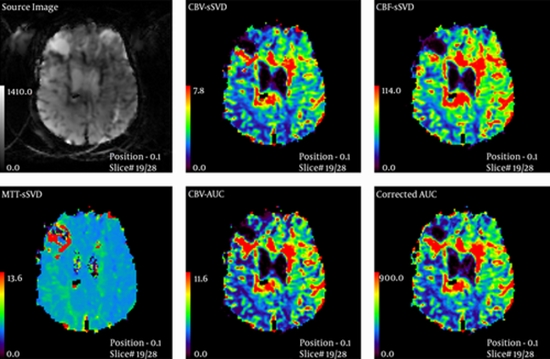
 Perfusion mri in Supratentorial Glioma Grading {faces}

Background

 Pre-operative glial brain tumor grading could determine the management. Perfusion weighted magnetic resonance imaging (PWMRI) is a promising modality for assessment and management of brain lesions.

Objectives

 In this study, we assessed the diagnostic efficacy of this method in the grading of supratentorial gliomas using 3 Tesla MRI.

Patients and Methods

 Using a 3 Tesla MRI unit, 35 (20 male, and 15 female) patients with glioma were examined one month before surgery. Imaging protocol was: 615 slices, field of view (FOV) 22 × 22 cm2 T1W spin echo: repetition time (TR) 500 -echo time (TE) 30 and (FOV) 22 × 22 cm2 T2W Turbo spin echo: TR 5000 -TE 90. Then 15 cc gadolinium was injected at the rate of 3cc/s and imaging was repeated with: TR: 2360 TE: 45, flip angle 90, band width 1346 echo planar imaging (EPI) 128 measurement 50. Mean transit time (MTT), cerebral blood flow (CBF) and cerebral blood volume (CBV) were measured at enhancing and edematous regions compared to contralateral white matter. Then, an appropriate biopsy was performed from different sites of the tumor during surgical excision. Standard hispathological examination that was assessed in a double-blinded manner, was considered as gold standard.

Results

 Patients’ tumor distribution was grade IV in 14 (40%), grade II in 14 (40%), grade III in six (17.1%) and grade I in one (2.9%). Relative CBF (rCBF), and rCBV was significantly more in high-grade glioma (HGG) versus low-grade glioma (LGG) (P < 0.001 and P < 0.009, respectively) and rCBF difference was more than rCBV but it was not significant. MTT was statistically the same in both groups and there was no difference between them. A value of rCBV greater than 2 showed a sensitivity of 90% and specificity of 67% and rCBF greater than 1.4 showed a sensitivity of 100% and a specificity of 74% in discrimination of high grade gliomas versus low grade gliomas.

Conclusion

 PWMRI is more accurate than conventional MRI for noninvasive discrimination of low-grade glioma (LGG) and high-grade glioma (HGG) that could be helpful for neurosurgeons in decision making dealing with the most common tumor of the brain.
  • Article_DOI : doi.org/10.5812/iranjradiol.13696
  • Author(s) : kavous firouznia ,seyyed mohammad ghodsi
  • News Group : research,research article
  • News Code : 278383
مدیر سایت
Author:

مدیر سایت

Enter your desired term to search
Theme settings