Advanced Diagnostic & Interventional Radiology Research Center | Kaiser score in the evaluation of breast cancer using MRI

Advanced Diagnostic & Interventional Radiology Research Center | Kaiser score in the evaluation of breast cancer using MRI
| Feb 12 2026
logo

Advanced Diagnostic & Interventional Radiology Research Center

COVID-19 pandemic 

During the COVID-19 pandemic, the Radiology Research Center at Tehran University of Medical Sciences continued its research activities despite the challenges posed by the increased demand for CT scans of COVID-19 patients and the necessity of adhering to strict health protocols. This center played a crucial role in improving medical imaging techniques, optimizing diagnostic protocols, and advancing technologies related to CT scan image analysis.

Faculty members, researchers, and staff remained committed to ensuring the safety and well-being of healthcare professionals and patients while actively engaging in imaging data analysis, developing artificial intelligence algorithms for faster disease detection, publishing scientific articles, and presenting their findings at international conferences. These efforts aimed to enhance diagnostic accuracy, improve treatment processes, and alleviate pressure on healthcare systems.


Key achievements of the Radiology Research Center during the COVID-19 pandemic include:


✔️ Development and optimization of lung imaging protocols for faster and more accurate COVID-19 diagnosis
✔️ Implementation of artificial intelligence technologies for automated CT scan analysis and reduced diagnosis time
✔️ Publication of high-impact research articles on innovative imaging methods for COVID-19 patients
✔️ Participation in national and international projects focused on COVID-19 diagnosis and patient management

The center remains dedicated to advancing research in medical imaging and continues to contribute as a leading scientific institution in improving the quality of diagnostic and therapeutic services.


Some of the center's significant achievements during the pandemic include:


  • Release Date : Jun 15 2025 - 12:07
  • : 106
  • Study time : 2 minute(s)

Diagnostic performance of Kaiser score in the evaluation of breast cancer using MRI: A systematic review and meta analysis
 {faces}

Purpose

To assess the performance of Kaiser score (KS) in detecting and characterizing breast cancer on magnetic resonance imaging (MRI).

Methods

The protocol was pre-registered at (https://osf.io/83c6j/). We performed a comprehensive search in PubMed, Embase, Cochrane Library, and Web of Science until 30 October 2024 for studies that used KS for detection of breast cancer on MRI. The risk of bias in the included studies was evaluated utilizing Quality Assessment of Diagnostic Accuracy Studies 2 (QUADAS-2). Diagnostic values of area under the curve (AUC), sensitivity, specificity, positive and negative likelihood ratios, and diagnostic odds ratio were calculated using a random-effects bivariate model. Meta-regression was used to explore the source of heterogeneity when I2 was ≥ 50 %. P-value < 0.05 was considered statistically significant.

Results

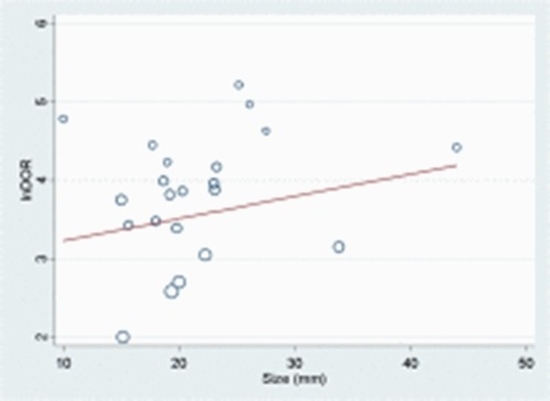
A total of 29 studies with 7918 patients and 8451 breast lesions were included. The pooled sensitivity, specificity, and AUC of KS for detecting malignant breast lesions on MRI were 95 % (95 % CI = 94 % to 96 %), 70 % (95 % CI = 64 % to 75 %), and 0.94 (95 % CI = 0.91 to 0.96), while for Breast Imaging Reporting and Data System (BI-RADS), they were 97 % (95 % CI = 92 % to 99 %), 46 % (95 % CI = 30 % to 62 %), and 0.89 (95 % CI = 0.86 to 0.91). Sensitivity difference was not statistically significant (p-value = 0.803), but specificity difference was significant (p-value = 0.001). Also, KS demonstrated slightly better diagnostic accuracy for mass lesions with a sensitivity of 96 % (95 % CI = 94 % to 97 %), specificity of 69 % (95 % CI = 60 % to 77 %), and AUC of 0.96 (95 % CI = 0.94 to 0.97) compared to non-mass lesions with 93 % (95 % CI = 88 % to 96 %), 68 % (95 % CI = 58 % to 77 %), and 0.91 (95 % CI = 0.88 to 0.94) values, respectively. KS showed better performance in larger lesions.

Conclusion

The KS’s superior diagnostic performance compared to BI-RADS, particularly its ability to avoid unnecessary biopsies, makes it valuable for diagnostic and clinical decision-making.
  • Article_DOI : 10.1016/j.ejrad.2025.112055
  • Author(s) : fahimeh zeinalkhani,saeed mohammadzadeh
  • News Group : research,research article
  • News Code : 299695
نفیسه سادات قوامی
Author:

نفیسه سادات قوامی

0 Comments for this article

comment

Post your comment:

متن درون تصویر را در جعبه متن زیر وارد نمائید *
Enter your desired term to search
Theme settings