Advanced Diagnostic & Interventional Radiology Research Center | Differentiation of edematous, tumoral and normal areas of brain

Advanced Diagnostic & Interventional Radiology Research Center | Differentiation of edematous, tumoral and normal areas of brain
| Dec 12 2025
logo

Advanced Diagnostic & Interventional Radiology Research Center

COVID-19 pandemic 

During the COVID-19 pandemic, the Radiology Research Center at Tehran University of Medical Sciences continued its research activities despite the challenges posed by the increased demand for CT scans of COVID-19 patients and the necessity of adhering to strict health protocols. This center played a crucial role in improving medical imaging techniques, optimizing diagnostic protocols, and advancing technologies related to CT scan image analysis.

Faculty members, researchers, and staff remained committed to ensuring the safety and well-being of healthcare professionals and patients while actively engaging in imaging data analysis, developing artificial intelligence algorithms for faster disease detection, publishing scientific articles, and presenting their findings at international conferences. These efforts aimed to enhance diagnostic accuracy, improve treatment processes, and alleviate pressure on healthcare systems.


Key achievements of the Radiology Research Center during the COVID-19 pandemic include:


✔️ Development and optimization of lung imaging protocols for faster and more accurate COVID-19 diagnosis
✔️ Implementation of artificial intelligence technologies for automated CT scan analysis and reduced diagnosis time
✔️ Publication of high-impact research articles on innovative imaging methods for COVID-19 patients
✔️ Participation in national and international projects focused on COVID-19 diagnosis and patient management

The center remains dedicated to advancing research in medical imaging and continues to contribute as a leading scientific institution in improving the quality of diagnostic and therapeutic services.


Some of the center's significant achievements during the pandemic include:


  • Release Date : Apr 3 2024 - 11:44
  • : 17
  • Study time : 1 minute(s)

Differentiation of edematous, tumoral and normal areas of brain using diffusion tensor and neurite orientation dispersion and density imaging
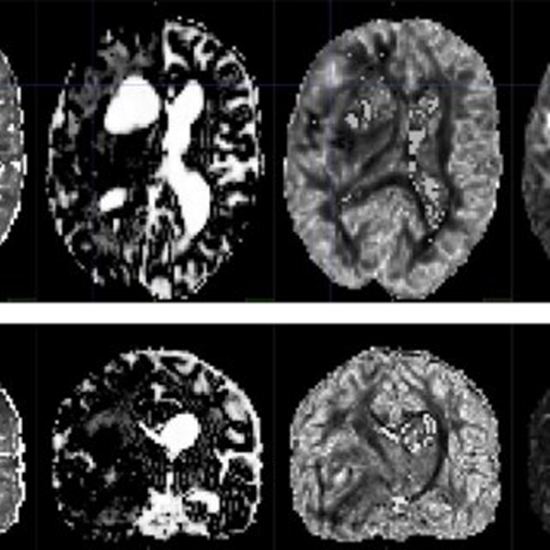
Differentiation of edematous, tumoral and normal areas of brain image modlities {faces}

Background

Presurigical planning for glioma tumor resection and radiotherapy treatment require proper delineation of tumoral and peritumoral areas of brain. Diffusion tensor imaging (DTI) is the most common mathematical model applied for diffusion weighted MRI data. Neurite orientation dispersion and density imaging (NODDI) is another mathematical model for DWI data modeling.

Objective

We studied whether extracted parameters of DTI, and NODDI models can be used to differentiate between edematous, tumoral, and normal areas in brain white matter (WM).

Material and Methods

12 patients with peritumoral edema underwent 3T multi-shell diffusion imaging with b-values of 1000 and 2000 smm-2 in 30 and 64 gradient directions, respectively. We fitted DTI and NODDI to data in manually drawn regions of interest and used their derived parameters to characterize edematous, tumoral and normal brain areas.

Results

We found that DTI parameters fractional anisotropy (FA), mean diffusivity (MD), axial diffusivity (AD) and radial diffusivity (RD) all significantly differentiated edematous from contralateral normal brain WM (p<0.005). However, only FA was found to distinguish between edematous WM fibers and tumor invaded fibers (p = 0.001). Among NODDI parameters, the intracellular volume fraction (ficvf) had the best distinguishing power with (p = 0.001) compared with the isotropic volume fraction (fiso), the orientation dispersion index (odi), and the concentration parameter of Watson distribution (κ), while comparing fibers inside normal, tumoral, and edematous areas.

Conclusion

The combination of two diffusion based methods, i.e. DTI and NODDI parameters can distinguish and characterize WM fibers involved in edematus, tumoral, and normal brain areas with reasonable confidence. Further studies will be required to improve the detectability of WM fibers inside the solid tumor if they hypothetically exist in tumoral parenchyma.

  • Article_DOI :
  • Author(s) : s masjoodi,ma oghabian
  • News Group : research,research article
  • News Code : 278404
مدیر سایت
Author:

مدیر سایت

Enter your desired term to search
Theme settings