Advanced Diagnostic & Interventional Radiology Research Center | Early growth response 1 transcription factor and its context-dep

Advanced Diagnostic & Interventional Radiology Research Center | Early growth response 1 transcription factor and its context-dep
| Dec 10 2025
logo

Advanced Diagnostic & Interventional Radiology Research Center

COVID-19 pandemic 

During the COVID-19 pandemic, the Radiology Research Center at Tehran University of Medical Sciences continued its research activities despite the challenges posed by the increased demand for CT scans of COVID-19 patients and the necessity of adhering to strict health protocols. This center played a crucial role in improving medical imaging techniques, optimizing diagnostic protocols, and advancing technologies related to CT scan image analysis.

Faculty members, researchers, and staff remained committed to ensuring the safety and well-being of healthcare professionals and patients while actively engaging in imaging data analysis, developing artificial intelligence algorithms for faster disease detection, publishing scientific articles, and presenting their findings at international conferences. These efforts aimed to enhance diagnostic accuracy, improve treatment processes, and alleviate pressure on healthcare systems.


Key achievements of the Radiology Research Center during the COVID-19 pandemic include:


✔️ Development and optimization of lung imaging protocols for faster and more accurate COVID-19 diagnosis
✔️ Implementation of artificial intelligence technologies for automated CT scan analysis and reduced diagnosis time
✔️ Publication of high-impact research articles on innovative imaging methods for COVID-19 patients
✔️ Participation in national and international projects focused on COVID-19 diagnosis and patient management

The center remains dedicated to advancing research in medical imaging and continues to contribute as a leading scientific institution in improving the quality of diagnostic and therapeutic services.


Some of the center's significant achievements during the pandemic include:


  • Release Date : Jul 16 2025 - 09:59
  • : 64
  • Study time : 1 minute(s)

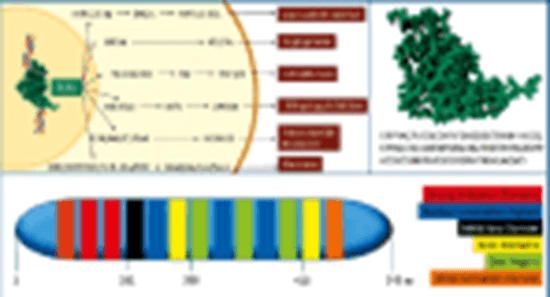
Early growth response 1 transcription factor and its context dependent functions in glioblastoma
 {faces}

Glioblastoma is the most aggressive form of primary brain tumour in adults. This tumour employs numerous transcription factors to advance and sustain its progression. Current evidence suggest that early growth response 1 (EGR1) plays a dual role as both an oncogene and a tumour suppressor in glioblastoma. Early growth response 1 expression is prevalent in glioblastoma, affecting over 80% of cases. Early growth response 1 regulatory roles extend to angiogenesis, cell adhesion, and resistance to chemotherapy, notably influencing pathways like hypoxia-inducible factor 1α and vascular endothelial growth factor A. Early growth response 1 can also induce cell adhesion, migration, chemoresistance against temozolomide, stemness, and self-renewal in glioblastoma cells. Despite its oncogenic functions, EGR1 can also suppress tumours by upregulating non-steroidal anti-inflammatory drug-activated gene 1 and phosphatase and tensin homolog deleted on chromosome ten, and inhibiting invasion and metastasis. Additionally, EGR1 may have hypothetical implications in the viral hit-and-run theory, particularly regarding cytomegalovirus infection. The key findings of this review are the context- dependent nature of EGR1's actions and its potential as a prognostic marker in glioblastoma. Further research is needed to understand EGR1's role fully and exploit its potential in clinics.

  • Article_DOI : 10.5114/wo.2024.142583
  • Author(s) : saleh rasras,mohammad bahadoram
  • News Group : research,research article
  • News Code : 301145
نفیسه سادات قوامی
Author:

نفیسه سادات قوامی

0 Comments for this article

comment

Post your comment:

متن درون تصویر را در جعبه متن زیر وارد نمائید *
Enter your desired term to search
Theme settings