Advanced Diagnostic & Interventional Radiology Research Center | color-doppler ultrasonography parameters of atherosclerotic caro

Advanced Diagnostic & Interventional Radiology Research Center | color-doppler ultrasonography parameters of atherosclerotic caro
| Aug 4 2026
logo

Advanced Diagnostic & Interventional Radiology Research Center

COVID-19 pandemic 

During the COVID-19 pandemic, the Radiology Research Center at Tehran University of Medical Sciences continued its research activities despite the challenges posed by the increased demand for CT scans of COVID-19 patients and the necessity of adhering to strict health protocols. This center played a crucial role in improving medical imaging techniques, optimizing diagnostic protocols, and advancing technologies related to CT scan image analysis.

Faculty members, researchers, and staff remained committed to ensuring the safety and well-being of healthcare professionals and patients while actively engaging in imaging data analysis, developing artificial intelligence algorithms for faster disease detection, publishing scientific articles, and presenting their findings at international conferences. These efforts aimed to enhance diagnostic accuracy, improve treatment processes, and alleviate pressure on healthcare systems.


Key achievements of the Radiology Research Center during the COVID-19 pandemic include:


✔️ Development and optimization of lung imaging protocols for faster and more accurate COVID-19 diagnosis
✔️ Implementation of artificial intelligence technologies for automated CT scan analysis and reduced diagnosis time
✔️ Publication of high-impact research articles on innovative imaging methods for COVID-19 patients
✔️ Participation in national and international projects focused on COVID-19 diagnosis and patient management

The center remains dedicated to advancing research in medical imaging and continues to contribute as a leading scientific institution in improving the quality of diagnostic and therapeutic services.


Some of the center's significant achievements during the pandemic include:


  • Release Date : Apr 2 2024 - 10:13
  • : 37
  • Study time : 1 minute(s)

Effect of high-dose atorvastatin therapy accompanied by discontinuation of cholesterol-rich diet on color-doppler ultrasonography parameters of atherosclerotic carotid artery
atorvastatin therapy & cholesterol diet on sonography parameters of atherosclerotic {faces}
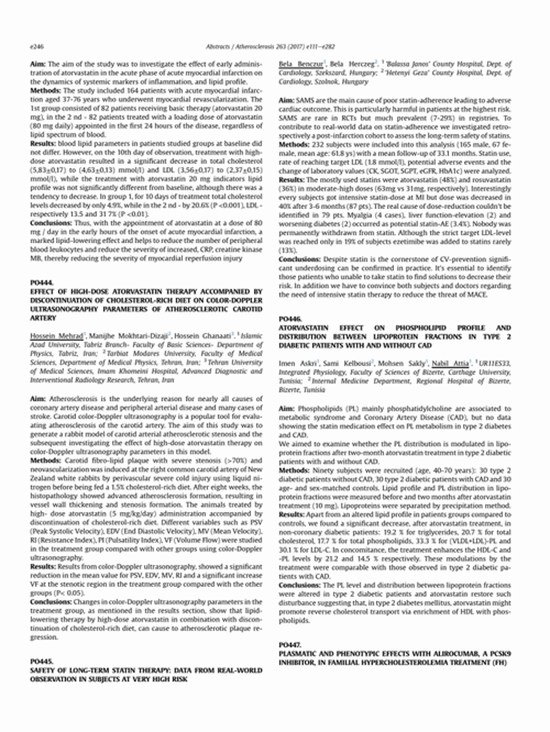
Aim: Atherosclerosis is the underlying reason for nearly all causes of coronary artery disease and peripheral arterial disease and many cases of stroke. Carotid color-Doppler ultrasonography is a popular tool for evaluating atherosclerosis of the carotid artery. The aim of this study was to generate a rabbit model of carotid arterial atherosclerotic stenosis and the subsequent investigating the effect of high-dose atorvastatin therapy on color-Doppler ultrasonography parameters in this model.
Methods: Carotid fibro-lipid plaque with severe stenosis (>70%) and neovascularization was induced at the right common carotid artery of New Zealand white rabbits by perivascular severe cold injury using liquid nitrogen before being fed a 1.5% cholesterol-rich diet. After eight weeks, the histopathology showed advanced atherosclerosis formation, resulting in vessel wall thickening and stenosis formation. The animals treated by high- dose atorvastatin (5 mg/kg/day) administration accompanied by discontinuation of cholesterol-rich diet. Different variables such as PSV (Peak Systolic Velocity), EDV (End Diastolic Velocity), MV (Mean Velocity), RI (Resistance Index), PI (Pulsatility Index), VF (Volume Flow) were studied in the treatment group compared with other groups using color-Doppler ultrasonography.
Results: Results from color-Doppler ultrasonography, showed a significant reduction in the mean value for PSV, EDV, MV, RI and a significant increase VF at the stenotic region in the treatment group compared with the other groups (P< 0.05).
Conclusions: Changes in color-Doppler ultrasonography parameters in the treatment group, as mentioned in the results section, show that lipid- lowering therapy by high-dose atorvastatin in combination with discontinuation of cholesterol-rich diet, can cause to atherosclerotic plaque regression.
  • Article_DOI : 10.1016/j.atherosclerosis.2017.06.797
  • Author(s) : hossein mehrad
  • News Group : research,research article
  • News Code : 278416
مدیر سایت
Author:

مدیر سایت

Enter your desired term to search
Theme settings