Advanced Diagnostic & Interventional Radiology Research Center | Bi-Iliac Distance of Sacrum by Sonography in the Second Trimeste

Advanced Diagnostic & Interventional Radiology Research Center | Bi-Iliac Distance of Sacrum by Sonography in the Second Trimeste
| Dec 12 2025
logo

Advanced Diagnostic & Interventional Radiology Research Center

COVID-19 pandemic 

During the COVID-19 pandemic, the Radiology Research Center at Tehran University of Medical Sciences continued its research activities despite the challenges posed by the increased demand for CT scans of COVID-19 patients and the necessity of adhering to strict health protocols. This center played a crucial role in improving medical imaging techniques, optimizing diagnostic protocols, and advancing technologies related to CT scan image analysis.

Faculty members, researchers, and staff remained committed to ensuring the safety and well-being of healthcare professionals and patients while actively engaging in imaging data analysis, developing artificial intelligence algorithms for faster disease detection, publishing scientific articles, and presenting their findings at international conferences. These efforts aimed to enhance diagnostic accuracy, improve treatment processes, and alleviate pressure on healthcare systems.


Key achievements of the Radiology Research Center during the COVID-19 pandemic include:


✔️ Development and optimization of lung imaging protocols for faster and more accurate COVID-19 diagnosis
✔️ Implementation of artificial intelligence technologies for automated CT scan analysis and reduced diagnosis time
✔️ Publication of high-impact research articles on innovative imaging methods for COVID-19 patients
✔️ Participation in national and international projects focused on COVID-19 diagnosis and patient management

The center remains dedicated to advancing research in medical imaging and continues to contribute as a leading scientific institution in improving the quality of diagnostic and therapeutic services.


Some of the center's significant achievements during the pandemic include:


  • Release Date : Jun 16 2024 - 08:09
  • : 10
  • Study time : 1 minute(s)

Evaluation of Bi-Iliac Distance and Timing of Ossification of Sacrum by Sonography in the Second Trimester of Pregnancy
Evaluation of Bi-Iliac Distance and Timing of Ossification {faces}

Background:

 The sacral region in the fetus can be involved in many pathologies such as spina bifida as the most common spinal abnormality and caudal regression syndrome. On this basis, knowledge about the temporal sequences of sacral ossification centers appearances and other characteristics including bi-iliac distance with newer higher resolution ultrasound technique may be helpful in defining pathologies involving the sacral region and fetal skeletal maturation.

Objectives:

 The goal of this research was to evaluate the timing of ossification of sacral vertebrae and bi-iliac distance as a guidance for clinicians to make an early and reliable diagnosis of sacral region anomalies such as caudal regression syndrome.

Patients and Methods:

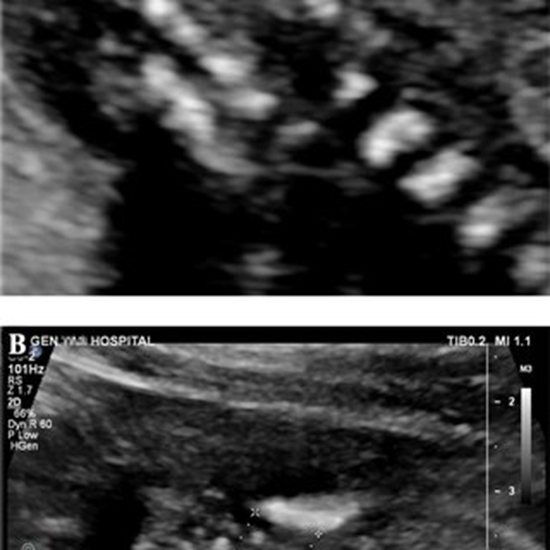
 This cross-sectional study was done on 315 normal pregnancies at 14 to 25 weeks of gestational age. The sacral region was evaluated in spine up position, on a coronal plane. By changing the orientation of the probe between sagittal and coronal planes and continuous observation, presence of the ossification center could be confirmed. Then, the level of the central and neural arch centers was recorded in every gestational age.

Results:

 Ossification happened in a predictable caudal direction pattern. S1 and body of S2 were visualized in all cases at 15 - 17 weeks + 6 days and all fetuses with 17 weeks of gestational age. The body of S3 was detected in all cases at 17 weeks and its arch at 20 weeks. Studying all fetuses at 18 weeks of gestation shows sacral ossification in the body and arch of S4. During the study period we had two cases with sirenomelia and three cases with sacral agenesis and we have explained their sacral region findings.

Conclusion:

 By using recent high-resolution ultrasound machines, sacral vertebral ossification centers could be identified in its early gestational age, which could be helpful for earlier detection of sacral pathologies.


  • Article_DOI : doi.org/10.5812/iranjradiol.79940
  • Author(s) : behnaz moradi ,abbas ghanbari
  • News Group : research,research article
  • News Code : 278311
مدیر سایت
Author:

مدیر سایت

Enter your desired term to search
Theme settings