


Exploring Neural Correlates of Different Dimensions in Drug Craving Self-Reports among Heroin Dependents
The new psychological models of drug craving for covering various dimensions of subjective craving self-reports based on their neurocognitive correspondence could potentially modify craving assessments in addiction medicine
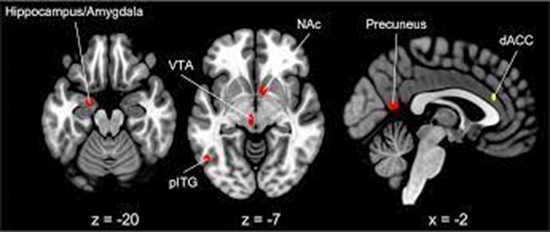
Introduction: Drug craving could be described as a motivational state which drives drug dependents towards drug seeking and use. Different types of self-reports such as craving feeling, desire and intention, wanting and need, imagery of use, and negative affect have been attributed to this motivational state. By using subjective self-reports for different correlates of drug craving along with functional neuroimaging with cue exposure paradigm, we investigated the brain regions that could correspond to different dimensions of subjective reports for heroin craving.
Methods: A total of 25 crystalline-heroin smokers underwent functional magnetic resonance imaging (fMRI), while viewing heroin-related and neutral cues presented in a block-design task. During trial intervals, subjects verbally reported their subjective feeling of cue induced craving (CIC). After fMRI procedure, participants reported the intensity of their "need for drug use" and "drug use imagination" on a 0-100 visual analog scale (VAS). Afterwards, they completed positive and negative affect scale (PANAS) and desire for drug questionnaire (DDQ) with 3 components of "desire and intention to drug use," "negative reinforcement," and "loss of control."
Results: The study showed significant correlation between "subjective feeling of craving" and activation of the left and right anterior cingulate cortex, as well as right medial frontal gyrus. Furthermore, the "desire and intention to drug use" was correlated with activation of the left precentral gyrus, left superior frontal gyrus, and left middle frontal gyrus. Subjects also exhibited significant correlation between the "need for drug use" and activation of the right inferior temporal gyrus, right middle temporal gyrus, and right parahippocampal gyrus. Correlation between subjective report of "heroin use imagination" and activation of the cerebellar vermis was also observed. Another significant correlation was between the "negative affect" and activation of the left precuneus, right putamen, and right middle temporal gyrus.
Discussion: This preliminary study proposes different neural correlates for various dimensions of subjective craving self-reports. It could reflect multidimensionality of cognitive functions corresponding with drug craving. These cognitive functions could represent their motivational and affective outcomes in a single item "subjective craving feeling" or in self-reports with multiple dissociable items, such as intention, need, imagination, or negative feeling. The new psychological models of drug craving for covering various dimensions of subjective craving self-reports based on their neurocognitive correspondence could potentially modify craving assessments in addiction medicine.


Send to friends