Advanced Diagnostic & Interventional Radiology Research Center | Exploring the interplay between epicardial fat

Advanced Diagnostic & Interventional Radiology Research Center | Exploring the interplay between epicardial fat
| Dec 16 2025
logo

Advanced Diagnostic & Interventional Radiology Research Center

COVID-19 pandemic 

During the COVID-19 pandemic, the Radiology Research Center at Tehran University of Medical Sciences continued its research activities despite the challenges posed by the increased demand for CT scans of COVID-19 patients and the necessity of adhering to strict health protocols. This center played a crucial role in improving medical imaging techniques, optimizing diagnostic protocols, and advancing technologies related to CT scan image analysis.

Faculty members, researchers, and staff remained committed to ensuring the safety and well-being of healthcare professionals and patients while actively engaging in imaging data analysis, developing artificial intelligence algorithms for faster disease detection, publishing scientific articles, and presenting their findings at international conferences. These efforts aimed to enhance diagnostic accuracy, improve treatment processes, and alleviate pressure on healthcare systems.


Key achievements of the Radiology Research Center during the COVID-19 pandemic include:


✔️ Development and optimization of lung imaging protocols for faster and more accurate COVID-19 diagnosis
✔️ Implementation of artificial intelligence technologies for automated CT scan analysis and reduced diagnosis time
✔️ Publication of high-impact research articles on innovative imaging methods for COVID-19 patients
✔️ Participation in national and international projects focused on COVID-19 diagnosis and patient management

The center remains dedicated to advancing research in medical imaging and continues to contribute as a leading scientific institution in improving the quality of diagnostic and therapeutic services.


Some of the center's significant achievements during the pandemic include:


  • Release Date : Jul 13 2025 - 12:21
  • : 55
  • Study time : 1 minute(s)

Exploring the interplay between epicardial fat, coronary artery calcium score, and nonalcoholic fatty liver disease through non ECG gated chest computed tomography: A cross sectional study
 {faces}

Background and Aims

This study examines the relationships between epicardial adipose tissue (EAT), nonalcoholic fatty liver disease (NAFLD), and coronary artery calcium score (CACS) using non‐ECG‐gated CT scans. It aims to determine the effectiveness of EAT measurements and NAFLD as predictors for coronary artery disease (CAD).

Methods

This cross‐sectional study was conducted at a specialized center, focusing on individuals who underwent non‐ECG‐gated chest CT scans without contrast. We evaluated EAT thickness and density in three areas: the right atrioventricular groove, the free wall of the right ventricle, and the central area of the right anterior interventricular groove. Additionally, we measured CACS and determined the presence of NAFLD by comparing liver‐to‐spleen density ratios. Statistical analyses, including regression models, were performed using SPSS (version 26).

Results

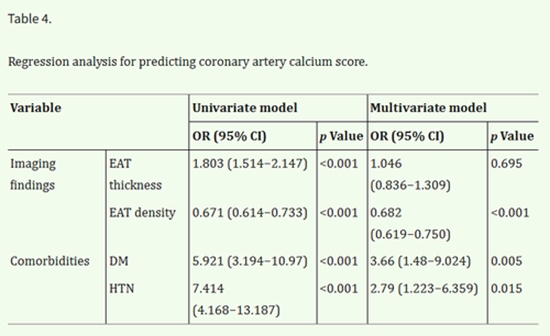
In this study, we enrolled 365 participants, including 203 males with an average age of 47 ± 17.93 years. EAT thickness was 6.28 ± 1.62 mm, and EAT density was −96.07 ± 12.47 Hounsfield units (HU). The mean CACS was 22.27 ± 79.01, and the mean liver density was 50.01 ± 10.76 HU. A significant positive correlation was observed between EAT thickness and CACS (r = 0.208, p < 0.001). EAT density showed a significant negative correlation with CACS (r = −0.155, p = 0.003). No correlation was found between NAFLD and CACS. Univariate logistic regression analysis identified significant predictors of increased CACS, including EAT thickness (OR: 1.803), EAT density (OR: 0.671), diabetes mellitus (DM) (OR: 5.921), and hypertension (HTN) (OR: 7.414). Multivariate analysis confirmed the significance of EAT thickness (OR: 0.682), DM (OR: 3.66), and HTN (OR: 2.79) as predictors of elevated CACS.

Conclusion

Our findings demonstrate that increased EAT thickness and decreased density are associated with higher CACS. Also, both DM and HTN significantly contribute to increased CACS. These results support the inclusion of EAT measurements in cardiovascular risk assessment models to enhance diagnostic accuracy.

  • Article_DOI : 10.1002/hsr2.70010
  • Author(s) : golnaz moradi
  • News Group : research,research article
  • News Code : 300809
نفیسه سادات قوامی
Author:

نفیسه سادات قوامی

0 Comments for this article

comment

Post your comment:

متن درون تصویر را در جعبه متن زیر وارد نمائید *
Enter your desired term to search
Theme settings