


Fluoroscopic analysis of anterior tibial translation during eccentric and concentric phase of knee rehabilitation exercises in men with anterior cruciate ligament injury
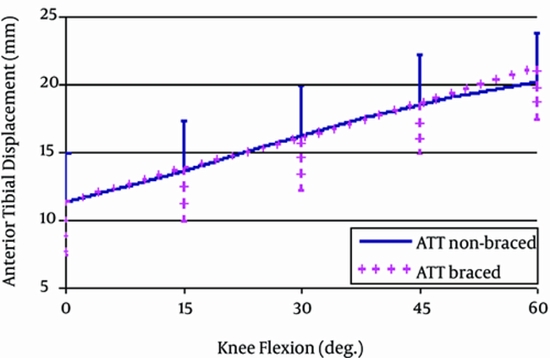
Background: The amount of anterior tibial translation during rehabilitation exercises is a key factor in organizing exercise regimen after anterior cruciate ligament injury. Excessive anterior tibial translation could increase the magnitude of tension imposed on injured and reconstructed anterior cruciate ligament knees. Forward lunge and open-kinetic knee extension exercises are commonly used in anterior cruciate ligament rehabilitation. However, there is insufficient data about the amount of anterior tibial translation in the eccentric and concentric phases of these exercises. This study compared the amount of anterior tibial translation in the eccentric and concentric phase of the lunge and seated knee extension in anterior cruciate ligament deficient and intact knees.
Methods: Using a non-probability sampling method, 14 men with unilateral anterior cruciate ligament rupture were selected for participation in this cross-sectional study. Participants were recruited from the university’s physiotherapy clinics. A uni-plane fluoroscope was used to image the knee joint while participants performed the forward lunge and open-kinetic knee extension exercises with the intact and injured legs in random order. Fluoroscopy imaging was performed in the radiology center at Sina Hospital, Tehran, Iran, from September 2013 to February 2014. Two factorial mixed ANOVA was used to analyze the data.
Results: There were no significant differences in the anterior tibial translation between the limbs and contraction phases during the lunge exercise. During open-kinetic knee extension, the anterior tibial translation in anterior cruciate ligament deficient knees was significantly more than that of healthy knees at 0⁰ (P=0.007). The anterior tibial translation in the eccentric phase of open-kinetic knee extension at flexion angles of 0⁰ (P=0.049) and 15⁰ (P=0.024) was significantly greater than that in the concentric phase.
Conclusion: In the lunge exercise, the amount of anterior tibial translation was similar between the eccentric and concentric phases and the intact and anterior cruciate ligament deficient knees, however, during open-kinetic knee extension exercise, in the eccentric phase was greater than that in concentric, and in the intact knees was greater than that in the intact knees, at 0-15⁰ angles


Send to friends