Advanced Diagnostic & Interventional Radiology Research Center | Identification of a novel homozygous mutation in the DDR2 gene from a patient with spondylo meta epiphyseal dysplasia by whole exome sequencing
Advanced Diagnostic & Interventional Radiology Research Center | Identification of a novel homozygous mutation in the DDR2 gene from a patient with spondylo meta epiphyseal dysplasia by whole exome sequencing
| Dec 10 2025
logo

Advanced Diagnostic & Interventional Radiology Research Center

COVID-19 pandemic 

During the COVID-19 pandemic, the Radiology Research Center at Tehran University of Medical Sciences continued its research activities despite the challenges posed by the increased demand for CT scans of COVID-19 patients and the necessity of adhering to strict health protocols. This center played a crucial role in improving medical imaging techniques, optimizing diagnostic protocols, and advancing technologies related to CT scan image analysis.

Faculty members, researchers, and staff remained committed to ensuring the safety and well-being of healthcare professionals and patients while actively engaging in imaging data analysis, developing artificial intelligence algorithms for faster disease detection, publishing scientific articles, and presenting their findings at international conferences. These efforts aimed to enhance diagnostic accuracy, improve treatment processes, and alleviate pressure on healthcare systems.


Key achievements of the Radiology Research Center during the COVID-19 pandemic include:


✔️ Development and optimization of lung imaging protocols for faster and more accurate COVID-19 diagnosis
✔️ Implementation of artificial intelligence technologies for automated CT scan analysis and reduced diagnosis time
✔️ Publication of high-impact research articles on innovative imaging methods for COVID-19 patients
✔️ Participation in national and international projects focused on COVID-19 diagnosis and patient management

The center remains dedicated to advancing research in medical imaging and continues to contribute as a leading scientific institution in improving the quality of diagnostic and therapeutic services.


Some of the center's significant achievements during the pandemic include:


  • Release Date : Jul 10 2024 - 09:28
  • : 85
  • Study time : 1 minute(s)

Identification of a novel homozygous mutation in the DDR2 gene from a patient with spondylo meta epiphyseal dysplasia by whole exome sequencing

 homozygous mutation in the DDR2 gene in spondylo-meta-epiphyseal dysplasia {faces}

Objectives: The spondylo-meta-epiphyseal dysplasia (SMED) short limbs-hand type is a rare autosomal recessive disease, which is characterized by premature calcification leading to severe disproportionate short stature and various skeletal changes. Defective function of a conserved region encoding discoidin domain receptor tyrosine kinase 2 (DDR2 protein) by the discoidin domain-containing receptor 2 (DDR2 gene) is cause of this disease. The purpose of present study was to investigate disease-causing mutations on DDR2 gene in an Iranian family with SMED, and predict the DDR2 protein molecular mechanism in development of SMED.

Materials and methods: In the present study, we evaluated a 2-year-old male with SMED. Detection of genetic changes in the studied patient was performed using Whole-Exome Sequencing (WES). PCR direct sequencing was performed for analysis of co-segregation of variants with the disease in family. Finally, in silico study was performed for further identification of molecular function of the identified genetic variant.

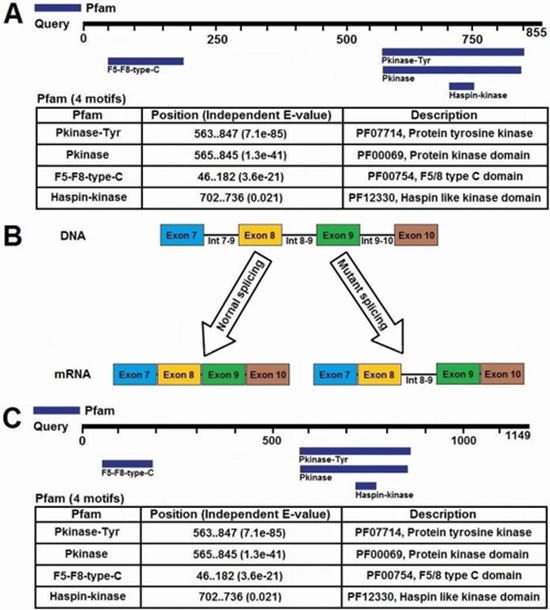
Results: We detected a novel splice-site mutation (NM_001014796: exon9: c.855+1G>A; NM_006182: exon8: c.855+1G>A) in DDR2 gene of the studied patient using WES. This mutation was exclusively detected in patients with homozygous SMED, not in healthy people. The effects of detected mutation on functions of DDR2 protein was predicted using in silico study.

Conclusion: The causative mutation in studied patient with SMED was identified using Next-generation sequencing (NGS), successfully. The identified novel mutation in DDR2 gene can be useful in prenatal diagnosis (PND) of SMED, preimplantation genetic diagnosis (PGD), and genetic counseling.

  • Article_DOI : 10.22038/IJBMS.2020.44487.10405
  • Author(s) : masoud heidari ,morteza soleyman-nejad ,alireza isazadeh
  • News Group : research,research article
  • News Code : 277991
مدیر سایت
Author:

مدیر سایت

Enter your desired term to search
Theme settings