Advanced Diagnostic & Interventional Radiology Research Center | Infratemporal fossa glial choristoma (Heterotopia)

Advanced Diagnostic & Interventional Radiology Research Center | Infratemporal fossa glial choristoma (Heterotopia)
| Jan 1 2026
logo

Advanced Diagnostic & Interventional Radiology Research Center

COVID-19 pandemic 

During the COVID-19 pandemic, the Radiology Research Center at Tehran University of Medical Sciences continued its research activities despite the challenges posed by the increased demand for CT scans of COVID-19 patients and the necessity of adhering to strict health protocols. This center played a crucial role in improving medical imaging techniques, optimizing diagnostic protocols, and advancing technologies related to CT scan image analysis.

Faculty members, researchers, and staff remained committed to ensuring the safety and well-being of healthcare professionals and patients while actively engaging in imaging data analysis, developing artificial intelligence algorithms for faster disease detection, publishing scientific articles, and presenting their findings at international conferences. These efforts aimed to enhance diagnostic accuracy, improve treatment processes, and alleviate pressure on healthcare systems.


Key achievements of the Radiology Research Center during the COVID-19 pandemic include:


✔️ Development and optimization of lung imaging protocols for faster and more accurate COVID-19 diagnosis
✔️ Implementation of artificial intelligence technologies for automated CT scan analysis and reduced diagnosis time
✔️ Publication of high-impact research articles on innovative imaging methods for COVID-19 patients
✔️ Participation in national and international projects focused on COVID-19 diagnosis and patient management

The center remains dedicated to advancing research in medical imaging and continues to contribute as a leading scientific institution in improving the quality of diagnostic and therapeutic services.


Some of the center's significant achievements during the pandemic include:


  • Release Date : Mar 16 2024 - 11:55
  • : 38
  • Study time : Less than one minute

Infratemporal fossa glial choristoma (Heterotopia): A rare presentation
Infratemporal fossa glial choristoma (Heterotopia) {faces}

A 7-month-old girl was referred to the head and neck department with a history of gradual painless swelling over the left side of her face for 4 months. Physical examination revealed asymmetric appearance of the face, with a 120 × 70 mm non-tender, non-mobile, and non-pulsatile prominent soft tissue mass with a smooth contour in the left parotid and periauricular spaces. Neurological examination was unremarkable.

On ultrasound examination, a solid cystic mass in the parotid space was recognized, but precise determination of the depth, margin, and extension of the mass was not possible, and complementary diagnostic studies were necessary.

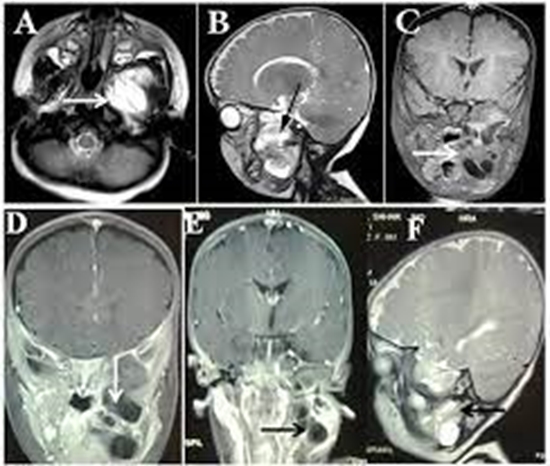
MRI of the skull base and face (​(1)1) in axial (A) and sagittal (B, F) T2-weighted, coronal unenhanced (C) and post-contrast (D, E) T1-weighted sequences shows a multilobulated solid-cystic soft tissue massoccupying the infratemporal fossa with extension into the parotid and parapharyngeal spaces, without any significant enhancement. The mass was exerting pressure on adjacent structures, with no obvious intracranial and brain communication.

  • Article_DOI : 10.5334/jbr-btr.818
  • Author(s) : leila aghaghazvini
  • News Group : research article,research
  • News Code : 278432
مدیر سیستم
Author:

مدیر سیستم

Enter your desired term to search
Theme settings