Advanced Diagnostic & Interventional Radiology Research Center | Mapping subnational HIV mortality in six Latin American countries with incomplete vital registration systems
Advanced Diagnostic & Interventional Radiology Research Center | Mapping subnational HIV mortality in six Latin American countries with incomplete vital registration systems
| Dec 12 2025
logo

Advanced Diagnostic & Interventional Radiology Research Center

COVID-19 pandemic 

During the COVID-19 pandemic, the Radiology Research Center at Tehran University of Medical Sciences continued its research activities despite the challenges posed by the increased demand for CT scans of COVID-19 patients and the necessity of adhering to strict health protocols. This center played a crucial role in improving medical imaging techniques, optimizing diagnostic protocols, and advancing technologies related to CT scan image analysis.

Faculty members, researchers, and staff remained committed to ensuring the safety and well-being of healthcare professionals and patients while actively engaging in imaging data analysis, developing artificial intelligence algorithms for faster disease detection, publishing scientific articles, and presenting their findings at international conferences. These efforts aimed to enhance diagnostic accuracy, improve treatment processes, and alleviate pressure on healthcare systems.


Key achievements of the Radiology Research Center during the COVID-19 pandemic include:


✔️ Development and optimization of lung imaging protocols for faster and more accurate COVID-19 diagnosis
✔️ Implementation of artificial intelligence technologies for automated CT scan analysis and reduced diagnosis time
✔️ Publication of high-impact research articles on innovative imaging methods for COVID-19 patients
✔️ Participation in national and international projects focused on COVID-19 diagnosis and patient management

The center remains dedicated to advancing research in medical imaging and continues to contribute as a leading scientific institution in improving the quality of diagnostic and therapeutic services.


Some of the center's significant achievements during the pandemic include:


  • Release Date : Jul 10 2024 - 09:02
  • : 97
  • Study time : 1 minute(s)

Mapping subnational HIV mortality in six Latin American countries with incomplete vital registration systems

 HIV mortality in six Latin American countries {faces}

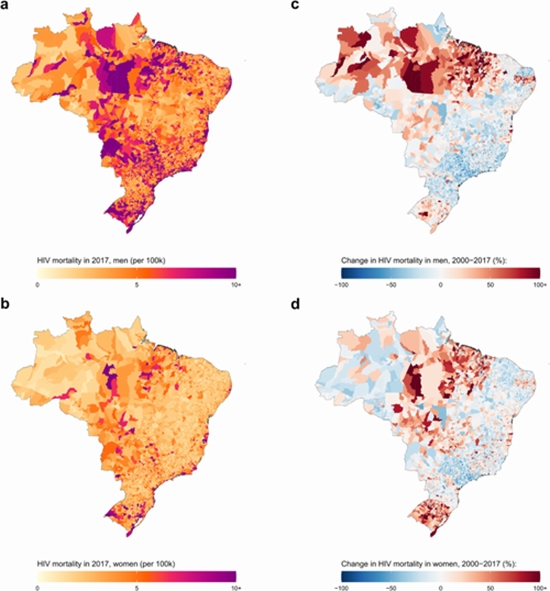
Background: Human immunodeficiency virus (HIV) remains a public health priority in Latin America. While the burden of HIV is historically concentrated in urban areas and high-risk groups, subnational estimates that cover multiple countries and years are missing. This paucity is partially due to incomplete vital registration (VR) systems and statistical challenges related to estimating mortality rates in areas with low numbers of HIV deaths. In this analysis, we address this gap and provide novel estimates of the HIV mortality rate and the number of HIV deaths by age group, sex, and municipality in Brazil, Colombia, Costa Rica, Ecuador, Guatemala, and Mexico.

Methods: We performed an ecological study using VR data ranging from 2000 to 2017, dependent on individual country data availability. We modeled HIV mortality using a Bayesian spatially explicit mixed-effects regression model that incorporates prior information on VR completeness. We calibrated our results to the Global Burden of Disease Study 2017.

Results: All countries displayed over a 40-fold difference in HIV mortality between municipalities with the highest and lowest age-standardized HIV mortality rate in the last year of study for men, and over a 20-fold difference for women. Despite decreases in national HIV mortality in all countries-apart from Ecuador-across the period of study, we found broad variation in relative changes in HIV mortality at the municipality level and increasing relative inequality over time in all countries. In all six countries included in this analysis, 50% or more HIV deaths were concentrated in fewer than 10% of municipalities in the latest year of study. In addition, national age patterns reflected shifts in mortality to older age groups-the median age group among decedents ranged from 30 to 45 years of age at the municipality level in Brazil, Colombia, and Mexico in 2017.

Conclusions: Our subnational estimates of HIV mortality revealed significant spatial variation and diverging local trends in HIV mortality over time and by age. This analysis provides a framework for incorporating data and uncertainty from incomplete VR systems and can help guide more geographically precise public health intervention to support HIV-related care and reduce HIV-related deaths.

  • Article_DOI : 10.1186/s12916-020-01876-4
  • Author(s) :
  • News Group : research,research article
  • News Code : 277993
مدیر سایت
Author:

مدیر سایت

Enter your desired term to search
Theme settings