Advanced Diagnostic & Interventional Radiology Research Center | Multimodality treatment in unresectable cholangiocarcinoma
Advanced Diagnostic & Interventional Radiology Research Center | Multimodality treatment in unresectable cholangiocarcinoma
| Dec 11 2025
logo

Advanced Diagnostic & Interventional Radiology Research Center

COVID-19 pandemic 

During the COVID-19 pandemic, the Radiology Research Center at Tehran University of Medical Sciences continued its research activities despite the challenges posed by the increased demand for CT scans of COVID-19 patients and the necessity of adhering to strict health protocols. This center played a crucial role in improving medical imaging techniques, optimizing diagnostic protocols, and advancing technologies related to CT scan image analysis.

Faculty members, researchers, and staff remained committed to ensuring the safety and well-being of healthcare professionals and patients while actively engaging in imaging data analysis, developing artificial intelligence algorithms for faster disease detection, publishing scientific articles, and presenting their findings at international conferences. These efforts aimed to enhance diagnostic accuracy, improve treatment processes, and alleviate pressure on healthcare systems.


Key achievements of the Radiology Research Center during the COVID-19 pandemic include:


✔️ Development and optimization of lung imaging protocols for faster and more accurate COVID-19 diagnosis
✔️ Implementation of artificial intelligence technologies for automated CT scan analysis and reduced diagnosis time
✔️ Publication of high-impact research articles on innovative imaging methods for COVID-19 patients
✔️ Participation in national and international projects focused on COVID-19 diagnosis and patient management

The center remains dedicated to advancing research in medical imaging and continues to contribute as a leading scientific institution in improving the quality of diagnostic and therapeutic services.


Some of the center's significant achievements during the pandemic include:


  • Release Date : Jun 19 2024 - 08:32
  • : 43
  • Study time : 1 minute(s)

Multimodality treatment in unresectable cholangiocarcinoma

Multimodality treatment in unresectable cholangiocarcinoma {faces}

Purpose

Cholangiocarcinomas (CCs) are rare and highly malignant cancers. Although there are different treatment protocols for treatment of cholangiocarcinoma, we aimed to investigate a survival rate of patients with unresectable extrahepatic CCs (ECCs) receiving multimodality therapeutic protocol (MTP) (biliary drainage + external beam radiotherapy [EBRT] + brachytherapy and systemic chemotherapy). Similarly, we aimed to identify a relationship between survival time and associated factors in treatment outcome.

Material and methods

This retrospective study was performed on patients with ECC, who were referred to our university hospital between 2012 and 2015, and their imaging were diagnosed as unresectable. Patients underwent MTP including internal-external drainage catheter (F10-12) with insertion under fluoroscopy guidance, EBRT with 25-28 fractions and concurrent chemotherapy using capecitabine (Xeloda) 825 mg/m2 at the days of radiotherapy, followed by brachytherapy (BT) with iridium-192 (192Ir) or cobalt-60 (60Co) sources for 21 Gy in 3 consecutive days. Demographic variables, complications, laboratory tests, imaging findings, and survival time (OS – overall survival after diagnosis; CS – survival after catheter placement) were recorded.

Results

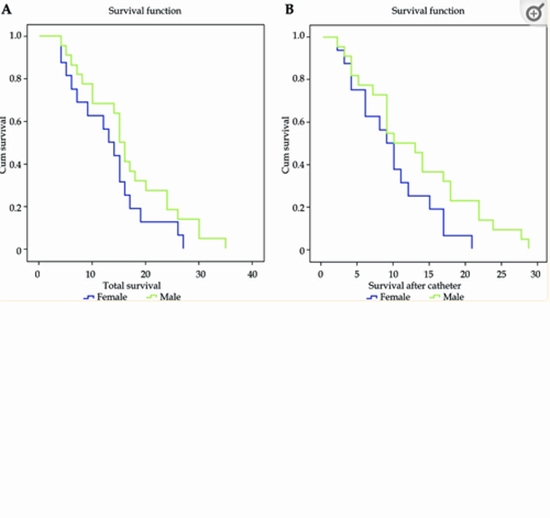
A total of 38 patients, with mean SD age = 58.08 (9.80) years, male = 22 (57.9%), were evaluated. According to Bismuth-Corlette classification, 15 (39.5%) were in stage IIIA, 5 (13.2%) were in stage IIIB, 10 (26.3%) were in stage IV, and 8 (21.2%) were undefined. Of those, 21 (55.3%), 15 (39.5%), and 17 (44.7%) were involved with liver parenchyma, great vessels, and regional lymph nodes, respectively. Mean SD of OS was 15.11 (8.10) months (median = 15; 95% CI: 13.25-16.69), and CS was 2-29 months (mean SD = 11.71 (7.29); median = 10; 95% CI: 10.05-13.37). Further analysis revealed a considerable decrease in OS and CS in those with an involvement of liver parenchyma, great vessels, regional lymph nodes, and Bismuth type IV.

Conclusions

Multimodality therapeutic approach in patients with inoperable ECCs could definitely improve their survival time and decrease complications. Survival time is significantly depending on tumor staging, gender, and involvement of liver parenchyma, great vessels, and regional lymph nodes.

  • Article_DOI : 10.5114/jcb.2020.94582
  • Author(s) : niloofar ayoobi yazdi,mahdi aghili
  • News Group : research,research article
  • News Code : 278285
مدیر سایت
Author:

مدیر سایت

Enter your desired term to search
Theme settings