Advanced Diagnostic & Interventional Radiology Research Center | Outcomes of Prostatic Artery Embolization

Advanced Diagnostic & Interventional Radiology Research Center | Outcomes of Prostatic Artery Embolization
| Dec 12 2025
logo

Advanced Diagnostic & Interventional Radiology Research Center

COVID-19 pandemic 

During the COVID-19 pandemic, the Radiology Research Center at Tehran University of Medical Sciences continued its research activities despite the challenges posed by the increased demand for CT scans of COVID-19 patients and the necessity of adhering to strict health protocols. This center played a crucial role in improving medical imaging techniques, optimizing diagnostic protocols, and advancing technologies related to CT scan image analysis.

Faculty members, researchers, and staff remained committed to ensuring the safety and well-being of healthcare professionals and patients while actively engaging in imaging data analysis, developing artificial intelligence algorithms for faster disease detection, publishing scientific articles, and presenting their findings at international conferences. These efforts aimed to enhance diagnostic accuracy, improve treatment processes, and alleviate pressure on healthcare systems.


Key achievements of the Radiology Research Center during the COVID-19 pandemic include:


✔️ Development and optimization of lung imaging protocols for faster and more accurate COVID-19 diagnosis
✔️ Implementation of artificial intelligence technologies for automated CT scan analysis and reduced diagnosis time
✔️ Publication of high-impact research articles on innovative imaging methods for COVID-19 patients
✔️ Participation in national and international projects focused on COVID-19 diagnosis and patient management

The center remains dedicated to advancing research in medical imaging and continues to contribute as a leading scientific institution in improving the quality of diagnostic and therapeutic services.


Some of the center's significant achievements during the pandemic include:


  • Release Date : Jun 18 2025 - 08:03
  • : 67
  • Study time : 1 minute(s)

Outcomes of Prostatic Artery Embolization for Treating Benign Prostatic Hyperplasia Symptoms: A Prospective Single Center Study
 {faces}

Background and Aims

Benign prostatic hyperplasia (BPH) is among the most common urologic conditions in elderly men, presenting with lower urinary tract symptoms. Prostatic artery embolization (PAE) is a recent interventional treatment for BPH.

Methods

This prospective single-center study reviewed the results of cases that underwent PAE for BPH from 2020 to 2022. Inclusion criteria were men with BPH refractory to pharmacologic treatment or those experiencing persistent adverse effects from medications, who were not candidates for surgical management. Assessments were made using ultrasonography for prostate volume and the International Prostate Symptom Score (IPSS) before and at 3 and 12 months after PAE. The clinical success rate of PAE was assessed according to the Cardiovascular and Interventional Radiological Society of Europe Standards of Practice. Recurrence of symptoms and complications after PAE were also recorded.

Results

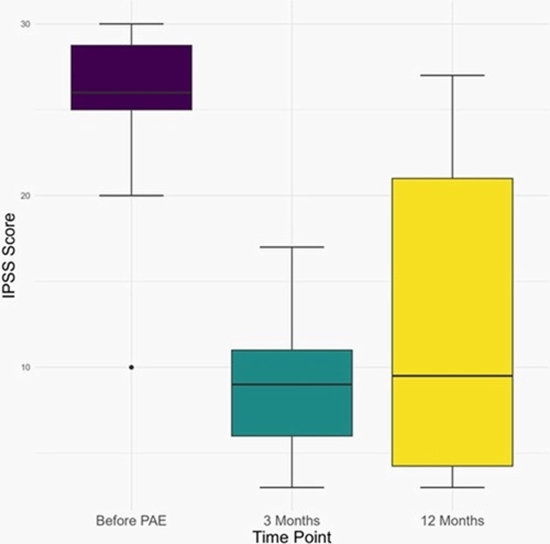
From a total of 46 included patients, clinical success was achieved in 93% at 3 months and 85% at 12 months. Complications occurred in eight (17.4%) cases, including five cases of erectile dysfunction and three cases of urinary tract infection. Eight (17.4%) cases had recurrent symptoms and required pharmacologic treatment, while seven (15.2%) needed surgery. The IPSS score dropped significantly at 3 months, with a mean difference of −16.2 (95% CI: −17.7 to −14.8) (p < 0.001), and at 12 months after PAE, with a mean difference of −13.5 (95% CI: −15.9 to −11.1) (p < 0.001). Prostate volume decreased significantly at 3 months, with a mean difference of −36.0 (95% CI: −43.0 to −29.0) (p < 0.001), and at 12 months, with a mean difference of −37.3 (95% CI: −43.7 to −31.0) (p < 0.001).

Conclusion

The findings of this study indicate that PAE is an effective therapeutic approach for patients with BPH, demonstrated by the low rates of adverse events and the absence of major complications.

  • Article_DOI : doi.org/10.1002/hsr2.70565
  • Author(s) : hossein ghanaati,sina delazar
  • News Group : research,research article
  • News Code : 299804
نفیسه سادات قوامی
Author:

نفیسه سادات قوامی

0 Comments for this article

comment

Post your comment:

متن درون تصویر را در جعبه متن زیر وارد نمائید *
Enter your desired term to search
Theme settings