Advanced Diagnostic & Interventional Radiology Research Center | Resting-state cardiac magnetic resonance perfusion imaging accuracy in diagnosing patients with coronary artery disease: A comparison with percutaneous coronary intervention
Advanced Diagnostic & Interventional Radiology Research Center | Resting-state cardiac magnetic resonance perfusion imaging accuracy in diagnosing patients with coronary artery disease: A comparison with percutaneous coronary intervention
| Dec 11 2025
logo

Advanced Diagnostic & Interventional Radiology Research Center

COVID-19 pandemic 

During the COVID-19 pandemic, the Radiology Research Center at Tehran University of Medical Sciences continued its research activities despite the challenges posed by the increased demand for CT scans of COVID-19 patients and the necessity of adhering to strict health protocols. This center played a crucial role in improving medical imaging techniques, optimizing diagnostic protocols, and advancing technologies related to CT scan image analysis.

Faculty members, researchers, and staff remained committed to ensuring the safety and well-being of healthcare professionals and patients while actively engaging in imaging data analysis, developing artificial intelligence algorithms for faster disease detection, publishing scientific articles, and presenting their findings at international conferences. These efforts aimed to enhance diagnostic accuracy, improve treatment processes, and alleviate pressure on healthcare systems.


Key achievements of the Radiology Research Center during the COVID-19 pandemic include:


✔️ Development and optimization of lung imaging protocols for faster and more accurate COVID-19 diagnosis
✔️ Implementation of artificial intelligence technologies for automated CT scan analysis and reduced diagnosis time
✔️ Publication of high-impact research articles on innovative imaging methods for COVID-19 patients
✔️ Participation in national and international projects focused on COVID-19 diagnosis and patient management

The center remains dedicated to advancing research in medical imaging and continues to contribute as a leading scientific institution in improving the quality of diagnostic and therapeutic services.


Some of the center's significant achievements during the pandemic include:


  • Release Date : Jul 10 2024 - 06:50
  • : 62
  • Study time : 1 minute(s)

Resting-state cardiac magnetic resonance perfusion imaging accuracy in diagnosing patients with coronary artery disease: A comparison with percutaneous coronary intervention

 coronary artery disease {faces}

Background: Myocardial ischemia may occur as a result of a variety of vascular and congenital conditions. There are different methods to assess ischemic myocardial tissue
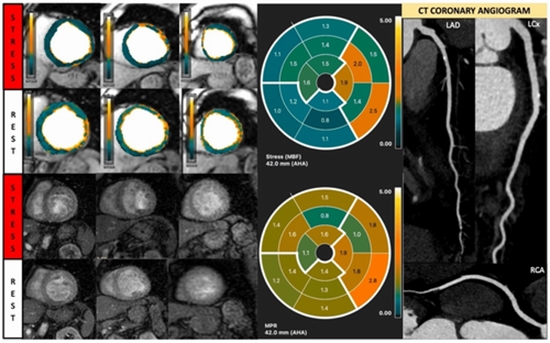
This study aimed to assess the diagnostic accuracy of cardiac magnetic resonance imaging (CMR) in advanced coronary artery disease (CAD).
 
Methods: Thirty patients with a predefined history of severe CAD underwent CMR with a 1.5 T CMR machine. The imaging protocol consisted of 4 steps: left ventricular functional imaging, T1-weighted contrast-enhanced magnetic resonance perfusion imaging, early gadolinium enhancement, and delayed gadolinium enhancement. The left ventricular functional indices and time-intensity curves (TICs) of the magnetic resonance perfusion imaging were calculated using a CMR analysis software tool. The TICs were drawn on 90 normal, early, and delayed gadolinium-enhanced territories under the guidance of percutaneous coronary angiography reports.
 
Results: Overall, 90 territories were derived from the 30 patients. Fifty-two territories were diagnosed with significant CAD and 38 with a normal coronary status. Our analysis revealed 35 regions with flattened TICs (increased time to peak, deceased maximum intensity, and more time-lasting plateaus) and 17 with normal patterns in diseased territories. From the total 38 angiographically normal regions, 36 regions presented normal TICs and 2 showed diseased patterns. The diagnostic accuracy, sensitivity, specificity, positive predictive value, and negative predictive value of CMR were 78.8%, 67.3%, 94.7%, 94.59%, and 67.92%, respectively, in comparison with percutaneous coronary angiography.
 
Conclusions: Resting-state CMR can be used to detect the presence of any severe/significant coronary artery lesion with an acceptable accuracy

  • Article_DOI :
  • Author(s) : ali zahedmehr,ali mohammadzadeh,sanaz pourtagh
  • News Group : research,research article
  • News Code : 277998
مدیر سایت
Author:

مدیر سایت

Enter your desired term to search
Theme settings