Advanced Diagnostic & Interventional Radiology Research Center | Sonographic Measurement of the Umbilical Cord and Its Vessels

Advanced Diagnostic & Interventional Radiology Research Center | Sonographic Measurement of the Umbilical Cord and Its Vessels
| Jan 3 2026
logo

Advanced Diagnostic & Interventional Radiology Research Center

COVID-19 pandemic 

During the COVID-19 pandemic, the Radiology Research Center at Tehran University of Medical Sciences continued its research activities despite the challenges posed by the increased demand for CT scans of COVID-19 patients and the necessity of adhering to strict health protocols. This center played a crucial role in improving medical imaging techniques, optimizing diagnostic protocols, and advancing technologies related to CT scan image analysis.

Faculty members, researchers, and staff remained committed to ensuring the safety and well-being of healthcare professionals and patients while actively engaging in imaging data analysis, developing artificial intelligence algorithms for faster disease detection, publishing scientific articles, and presenting their findings at international conferences. These efforts aimed to enhance diagnostic accuracy, improve treatment processes, and alleviate pressure on healthcare systems.


Key achievements of the Radiology Research Center during the COVID-19 pandemic include:


✔️ Development and optimization of lung imaging protocols for faster and more accurate COVID-19 diagnosis
✔️ Implementation of artificial intelligence technologies for automated CT scan analysis and reduced diagnosis time
✔️ Publication of high-impact research articles on innovative imaging methods for COVID-19 patients
✔️ Participation in national and international projects focused on COVID-19 diagnosis and patient management

The center remains dedicated to advancing research in medical imaging and continues to contribute as a leading scientific institution in improving the quality of diagnostic and therapeutic services.


Some of the center's significant achievements during the pandemic include:


  • Release Date : Mar 5 2024 - 12:18
  • : 25
  • Study time : 1 minute(s)

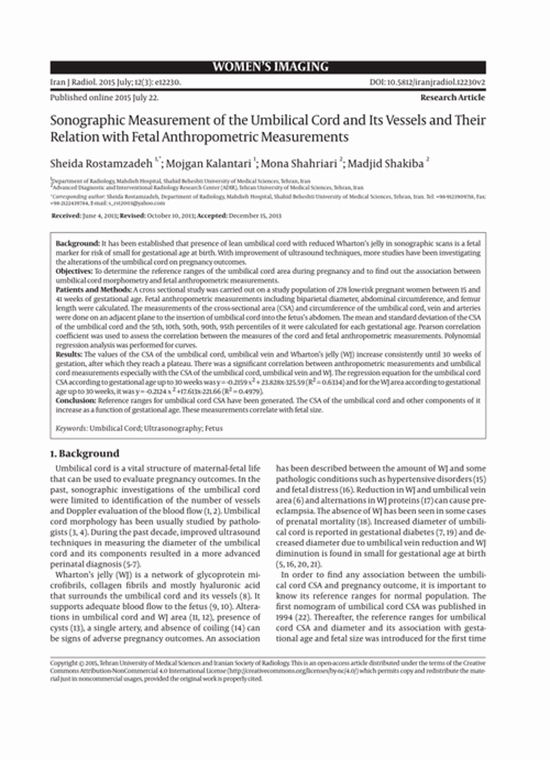
Sonographic Measurement of the Umbilical Cord and Its Vessels and Their Relation with Fetal Anthropometric Measurements
Sonographic of the Umbilical Cord and Their Relation with Fetal Anthropometric  {faces}

Abstract

Background: It has been established that presence of lean umbilical cord with reduced Wharton's jelly in sonographic scans is a fetal marker for risk of small for gestational age at birth. With improvement of ultrasound techniques, more studies have been investigating the alterations of the umbilical cord on pregnancy outcomes.

Objectives: To determine the reference ranges of the umbilical cord area during pregnancy and to find out the association between umbilical cord morphometry and fetal anthropometric measurements.

Patients and methods: A cross sectional study was carried out on a study population of 278 low-risk pregnant women between 15 and 41 weeks of gestational age. Fetal anthropometric measurements including biparietal diameter, abdominal circumference, and femur length were calculated. The measurements of the cross-sectional area (CSA) and circumference of the umbilical cord, vein and arteries were done on an adjacent plane to the insertion of umbilical cord into the fetus's abdomen. The mean and standard deviation of the CSA of the umbilical cord and the 5th, 10th, 50th, 90th, 95th percentiles of it were calculated for each gestational age. Pearson correlation coefficient was used to assess the correlation between the measures of the cord and fetal anthropometric measurements. Polynomial regression analysis was performed for curves.

Results: The values of the CSA of the umbilical cord, umbilical vein and Wharton's jelly (WJ) increase consistently until 30 weeks of gestation, after which they reach a plateau. There was a significant correlation between anthropometric measurements and umbilical cord measurements especially with the CSA of the umbilical cord, umbilical vein and WJ. The regression equation for the umbilical cord CSA according to gestational age up to 30 weeks was y = -0.2159 x(2) + 23.828x-325.59 (R(2) = 0.6334) and for the WJ area according to gestational age up to 30 weeks, it was y = -0.2124 x (2) +17.613x-221.66 (R(2) = 0.4979).

Conclusion: Reference ranges for umbilical cord CSA have been generated. The CSA of the umbilical cord and other components of it increase as a function of gestational age. These measurements correlate with fetal size.


  • Article_DOI : 10.5812/iranjradiol.12230v2
  • Author(s) : sheida rostamzadeh
  • News Group : research,research article
  • News Code : 278456
مدیر سایت
Author:

مدیر سایت

Enter your desired term to search
Theme settings