Advanced Diagnostic & Interventional Radiology Research Center | characterizing ovarian masses with solid components

Advanced Diagnostic & Interventional Radiology Research Center | characterizing ovarian masses with solid components
| Aug 4 2026
logo

Advanced Diagnostic & Interventional Radiology Research Center

COVID-19 pandemic 

During the COVID-19 pandemic, the Radiology Research Center at Tehran University of Medical Sciences continued its research activities despite the challenges posed by the increased demand for CT scans of COVID-19 patients and the necessity of adhering to strict health protocols. This center played a crucial role in improving medical imaging techniques, optimizing diagnostic protocols, and advancing technologies related to CT scan image analysis.

Faculty members, researchers, and staff remained committed to ensuring the safety and well-being of healthcare professionals and patients while actively engaging in imaging data analysis, developing artificial intelligence algorithms for faster disease detection, publishing scientific articles, and presenting their findings at international conferences. These efforts aimed to enhance diagnostic accuracy, improve treatment processes, and alleviate pressure on healthcare systems.


Key achievements of the Radiology Research Center during the COVID-19 pandemic include:


✔️ Development and optimization of lung imaging protocols for faster and more accurate COVID-19 diagnosis
✔️ Implementation of artificial intelligence technologies for automated CT scan analysis and reduced diagnosis time
✔️ Publication of high-impact research articles on innovative imaging methods for COVID-19 patients
✔️ Participation in national and international projects focused on COVID-19 diagnosis and patient management

The center remains dedicated to advancing research in medical imaging and continues to contribute as a leading scientific institution in improving the quality of diagnostic and therapeutic services.


Some of the center's significant achievements during the pandemic include:


  • Release Date : Feb 22 2026 - 10:09
  • : 50
  • Study time : 1 minute(s)

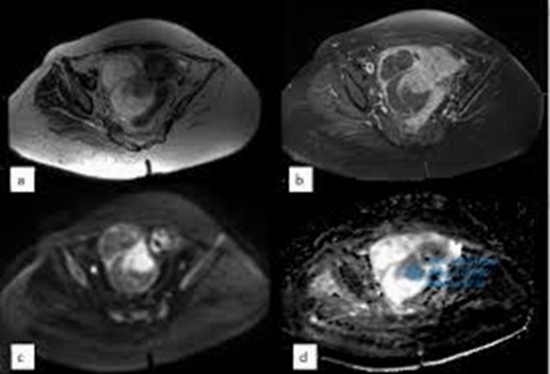
The added value of apparent diffusion coefficient assessments in O-RADS MRI evaluation for characterizing ovarian masses with solid components
 characterizing ovarian masses with solid components {faces}

Background: Integrating diffusion-weighted imaging (DWI) and apparent diffusion coefficient (ADC) measurements with existing MR imaging protocols improves the differentiation between benign and malignant adnexal lesions. We aimed to assess the additional value of quantitative ADC in diagnosing adnexal masses classified by the O-RADS-MRI score and evaluate the impact on diagnostic performance.

Methods: This retrospective cohort study analyzed 159 patients with 218 ovarian masses, classified into benign, borderline, and malignant groups via histopathological evaluation. We examined MRI parameters, including solid component size and signal intensity, time-intensity curves (TICs), ADC values and O-RADS categories. Receiver Operating Characteristic (ROC) curve analysis determined optimal ADC cut-off values for differentiating tumor classifications.

Results: The optimal cut-off values for the ADC between O-RADS MRI categories 3-4, and 4-5, were 1.36 × 10⁻³ mm²/sec and 0.99 × 10⁻³ mm²/sec respectively. the introduction of ORADS-ADC classification, utilizing these ADC cut-offs demonstrated superior diagnostic performance compared to traditional O-RADS, with improvements observed across several metrics: in ORADS-ADC 3-4 sensitivity increases from 69.2 to 94.12%, specificity from 88.4 to 98.36%, and accuracy from 76.0 to 96.84%. Similarly, in ORADS-ADC 4-5 sensitivity increases from 91.8 to 95.12%, specificity from 62.3 to 97.06%, and accuracy from 78.9 to 95.54%.

Conclusion: Incorporating DWI and ADC measurements into the O-RADS MRI classification system significantly improves ovarian tumor classification. The ORADS-ADC model markedly increases diagnostic accuracy, enhancing both sensitivity and specificity compared to traditional O-RADS, which consequently enhances clinical and therapeutic management resulting in better patient outcomes during surgical planning.

  • Article_DOI :
  • Author(s) : behnaz moradi ,soroor kalantari
  • News Group : research,research article
  • News Code : 316030
نفیسه سادات قوامی
Author:

نفیسه سادات قوامی

0 Comments for this article

comment

Post your comment:

متن درون تصویر را در جعبه متن زیر وارد نمائید *
Enter your desired term to search
Theme settings