Advanced Diagnostic & Interventional Radiology Research Center | The global burden of cancer attributable to risk factors, 2010/19: a systematic analysis for the Global Burden of Disease Study 2019
Advanced Diagnostic & Interventional Radiology Research Center | The global burden of cancer attributable to risk factors, 2010/19: a systematic analysis for the Global Burden of Disease Study 2019
| Dec 11 2025
logo

Advanced Diagnostic & Interventional Radiology Research Center

COVID-19 pandemic 

During the COVID-19 pandemic, the Radiology Research Center at Tehran University of Medical Sciences continued its research activities despite the challenges posed by the increased demand for CT scans of COVID-19 patients and the necessity of adhering to strict health protocols. This center played a crucial role in improving medical imaging techniques, optimizing diagnostic protocols, and advancing technologies related to CT scan image analysis.

Faculty members, researchers, and staff remained committed to ensuring the safety and well-being of healthcare professionals and patients while actively engaging in imaging data analysis, developing artificial intelligence algorithms for faster disease detection, publishing scientific articles, and presenting their findings at international conferences. These efforts aimed to enhance diagnostic accuracy, improve treatment processes, and alleviate pressure on healthcare systems.


Key achievements of the Radiology Research Center during the COVID-19 pandemic include:


✔️ Development and optimization of lung imaging protocols for faster and more accurate COVID-19 diagnosis
✔️ Implementation of artificial intelligence technologies for automated CT scan analysis and reduced diagnosis time
✔️ Publication of high-impact research articles on innovative imaging methods for COVID-19 patients
✔️ Participation in national and international projects focused on COVID-19 diagnosis and patient management

The center remains dedicated to advancing research in medical imaging and continues to contribute as a leading scientific institution in improving the quality of diagnostic and therapeutic services.


Some of the center's significant achievements during the pandemic include:


  • Release Date : Jul 24 2024 - 11:17
  • : 117
  • Study time : 2 minute(s)

The global burden of cancer attributable to risk factors, 2010/19: a systematic analysis for the Global Burden of Disease Study 2019

 {faces}

Background: Understanding the magnitude of cancer burden attributable to potentially modifiable risk factors is crucial for development of effective prevention and mitigation strategies. We analysed results from the Global Burden of Diseases, Injuries, and Risk Factors Study (GBD) 2019 to inform cancer control planning efforts globally.

Methods: The GBD 2019 comparative risk assessment framework was used to estimate cancer burden attributable to behavioural, environmental and occupational, and metabolic risk factors. A total of 82 risk-outcome pairs were included on the basis of the World Cancer Research Fund criteria. Estimated cancer deaths and disability-adjusted life-years (DALYs) in 2019 and change in these measures between 2010 and 2019 are presented.

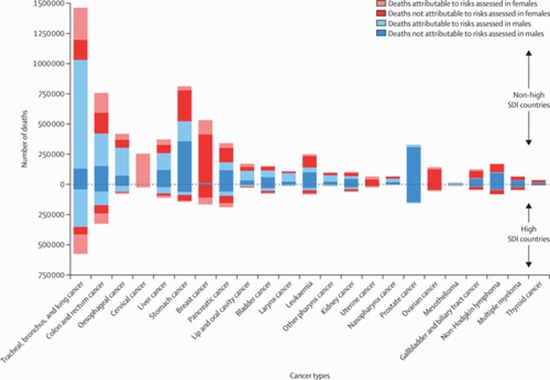
Findings: Globally, in 2019, the risk factors included in this analysis accounted for 4·45 million (95% uncertainty interval 4·01-4·94) deaths and 105 million (95·0-116) DALYs for both sexes combined, representing 44·4% (41·3-48·4) of all cancer deaths and 42·0% (39·1-45·6) of all DALYs. There were 2·88 million (2·60-3·18) risk-attributable cancer deaths in males (50·6% [47·8-54·1] of all male cancer deaths) and 1·58 million (1·36-1·84) risk-attributable cancer deaths in females (36·3% [32·5-41·3] of all female cancer deaths). The leading risk factors at the most detailed level globally for risk-attributable cancer deaths and DALYs in 2019 for both sexes combined were smoking, followed by alcohol use and high BMI. Risk-attributable cancer burden varied by world region and Socio-demographic Index (SDI), with smoking, unsafe sex, and alcohol use being the three leading risk factors for risk-attributable cancer DALYs in low SDI locations in 2019, whereas DALYs in high SDI locations mirrored the top three global risk factor rankings. From 2010 to 2019, global risk-attributable cancer deaths increased by 20·4% (12·6-28·4) and DALYs by 16·8% (8·8-25·0), with the greatest percentage increase in metabolic risks (34·7% [27·9-42·8] and 33·3% [25·8-42·0]).

Interpretation: The leading risk factors contributing to global cancer burden in 2019 were behavioural, whereas metabolic risk factors saw the largest increases between 2010 and 2019. Reducing exposure to these modifiable risk factors would decrease cancer mortality and DALY rates worldwide, and policies should be tailored appropriately to local cancer risk factor burden.

  • Article_DOI : 10.1016/S0140-6736(22)01438-6
  • Author(s) :
  • News Group : research,articles,research article
  • News Code : 277921
مدیر سایت
Author:

مدیر سایت

0 Comments for this article

comment

Post your comment:

متن درون تصویر را در جعبه متن زیر وارد نمائید *
Enter your desired term to search
Theme settings