Advanced Diagnostic & Interventional Radiology Research Center | The role of FOXC1/FOXCUT/DANCR axis in triple negative breast cancer: a bioinformatics and experimental approach
Advanced Diagnostic & Interventional Radiology Research Center | The role of FOXC1/FOXCUT/DANCR axis in triple negative breast cancer: a bioinformatics and experimental approach
| Dec 10 2025
logo

Advanced Diagnostic & Interventional Radiology Research Center

COVID-19 pandemic 

During the COVID-19 pandemic, the Radiology Research Center at Tehran University of Medical Sciences continued its research activities despite the challenges posed by the increased demand for CT scans of COVID-19 patients and the necessity of adhering to strict health protocols. This center played a crucial role in improving medical imaging techniques, optimizing diagnostic protocols, and advancing technologies related to CT scan image analysis.

Faculty members, researchers, and staff remained committed to ensuring the safety and well-being of healthcare professionals and patients while actively engaging in imaging data analysis, developing artificial intelligence algorithms for faster disease detection, publishing scientific articles, and presenting their findings at international conferences. These efforts aimed to enhance diagnostic accuracy, improve treatment processes, and alleviate pressure on healthcare systems.


Key achievements of the Radiology Research Center during the COVID-19 pandemic include:


✔️ Development and optimization of lung imaging protocols for faster and more accurate COVID-19 diagnosis
✔️ Implementation of artificial intelligence technologies for automated CT scan analysis and reduced diagnosis time
✔️ Publication of high-impact research articles on innovative imaging methods for COVID-19 patients
✔️ Participation in national and international projects focused on COVID-19 diagnosis and patient management

The center remains dedicated to advancing research in medical imaging and continues to contribute as a leading scientific institution in improving the quality of diagnostic and therapeutic services.


Some of the center's significant achievements during the pandemic include:


  • Release Date : Jul 23 2024 - 11:18
  • : 115
  • Study time : 1 minute(s)

The role of FOXC1/FOXCUT/DANCR axis in triple negative breast cancer: a bioinformatics and experimental approach

 role of FOXC1/FOXCUT/DANCR axis in triple negative breast cancer {faces}

Background: Triple-negative breast cancer (TNBC) is the most challenging subtype of breast cancer and does not benefit from the existing targeted therapies. In the present study, we used bioinformatics and experimental approaches to assess the genes that are somehow involved in the epithelial-mesenchymal transition (EMT) pathway which may explain the invasive features of TNBC.

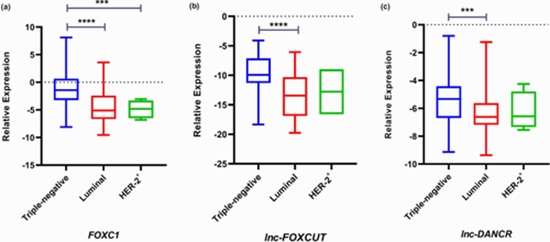
Method and results: We analyzed five GEO datasets consisting of 657 breast tumors by GEO2R online software to achieve common differentially expressed genes (DEGs) between TNBC and non-TNBC tumors. The expression of the selected coding and non-coding genes was validated in 100 breast tumors, including fifty TNBC and fifty non-TNBC samples, using quantitative Real-Time PCR (qRT-PCR). The bioinformatics approach resulted in a final DEG list consisting of ten upregulated and seventeen downregulated genes (logFC ≥|1| and P < 0.05). Co-expression network construction indicated the FOXC1 transcription factor as a central hub node. Considering the notable role of FOXC1 in EMT, the expression levels of FOXC1-related lncRNAs, lnc-FOXCUT and lnc-DANCR, were also evaluated in the studied tumors. The results of qRT-PCR confirmed notable upregulation of FOXC1, lnc-FOXCUT, and lnc-DANCR in TNBC tissues compared to non-TNBC samples (P < 0.0001, P = 0.0005, and P = 0.0008, respectively). Moreover, ROC curve analysis revealed the potential biomarker role of FOXC1 in TNBC samples.

Conclusion: Present study suggested that the deregulation of FOXC1/lnc-FOXCUT/lnc-DANCR axis may contribute to the aggressive features of triple-negative breast tumors. Therefore, this axis may be considered as a new probable therapeutic target in the treatment of TNBC.

Keywords: Bioinformatics; FOXC1; Lnc-DANCR; Lnc-FOXCUT; Triple-negative breast cancer.

  • Article_DOI : 10.1007/s11033-021-07093-3
  • Author(s) : nasrin ahmadinejad,zeeba kamaliyan,reza mirfakhraie, ghasem azizi-tabesh,farzaneh darbeheshti,ramesh omranipour,elham zokaei,vahid-reza yassaee
  • News Group : research,research article
  • News Code : 277935
مدیر سایت
Author:

مدیر سایت

0 Comments for this article

comment

Post your comment:

متن درون تصویر را در جعبه متن زیر وارد نمائید *
Enter your desired term to search
Theme settings