


Assessment of LI RADS efficacy in classification of hepatocellular carcinoma and benign liver nodules using DCE MRI features and machine learning
Purpose
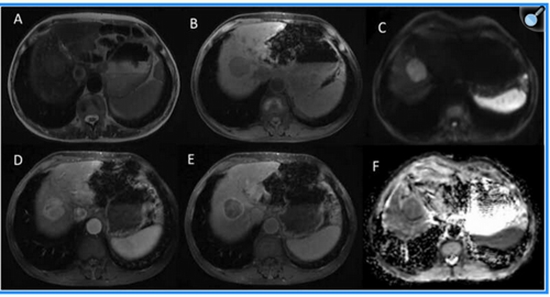
The current study aimed to evaluate the efficiency of dynamic contrast-enhanced (DCE) MRI visual features in classifying benign liver nodules and hepatocellular carcinoma (HCC) using a machine learning model.
Methods
115 LI-RADS3, 137 LI-RADS4, and 140 LI-RADS5 nodules were included (392 nodules from 245 patients), which were evaluated by follow-up imaging for LR-3 and pathology results for LR-4 and LR-5 nodules. Data was collected retrospectively from 3 T and 1.5 T MRI scanners. All the lesions were categorized into 124 benign and 268 HCC lesions. Visual features included tumor size, arterial-phase hyper-enhancement (APHE), washout, lesion segment, mass/mass-like, and capsule presence. Gini-importance method extracted the most important features to prevent over-fitting. Final dataset was split into training(70%), validation(10%), and test dataset(20%). The SVM model was used to train the classifying algorithm. For model validation, 5-fold cross-validation was utilized, and the test data set was used to assess the final accuracy. The area under the curve and receiver operating characteristic curves were used to assess the performance of the classifier model.
Results
For test dataset, the accuracy, sensitivity, and specificity values for classifying benign and HCC lesions were 82%,84%, and 81%, respectively. APHE, washout, tumor size, and mass/mass-like features significantly differentiated benign and HCC lesions with p-value < .001.
Conclusions
The developed classification model employing DCE-MRI features showed significant performance of visual features in classifying benign and HCC lesions. Our study also highlighted the significance of mass and mass-like features in addition to LI-RADS categorization. For future work, this study suggests developing a deep-learning algorithm for automatic lesion segmentation and feature assessment to reduce lesion categorization errors.


comment