

Loud, non-stethoscope audible pulsatile tinnitus and papilledema: A rare presentation of dural arteriovenous fistula
Background
Dural arteriovenous fistulas (DAVFs) are artery-to-vein shunts within dura mater, often without a distinctive vascular nidus (Cognard et al., 1995). Tinnitus is the chief complaint of 56% of these patients. Risk of hemorrhage of DAVFs seems to be related to the pattern of venous drainage. Cognard et al, had presented a classification scheme that reflected prognosis and risk of neurologic complication in untreated DAVFs (table I) (Cognard et al., 1995).
This article is the report of a patient
Case report
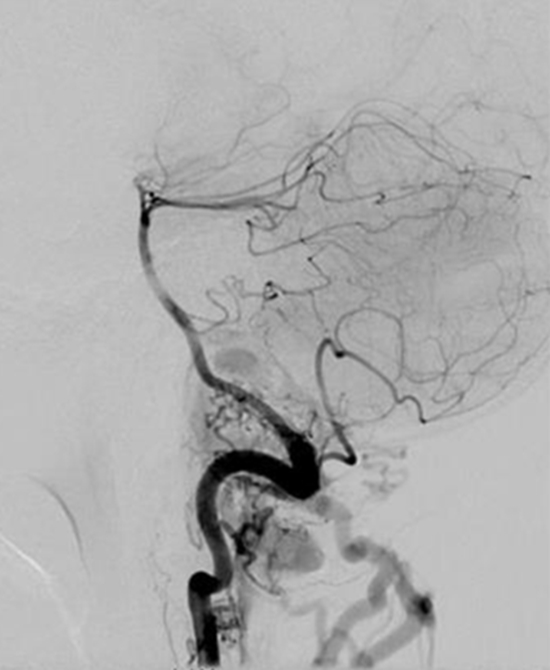
A 42 year-old woman referred to our hospital complaining of persistent, pulsatile tinnitus in her left ear over a period of two months. She claimed that her family members were able to hear tinnitus by putting their ear on patient’s trunk.
Ophthalmic examination revealed bilateral papilledema with normal visual acuity and enlargement of blind spots in perimetry. Left sided objective pulsatile tinnitus, which was audible even without instrument on her trunk, was also detected. Although brain
Discussion
Pulsatile tinnitus is a rhythmic noise often synchronous with heart beat. Arteriovenous malformations (AVMs), dural AVFs, carotid-cavernous fistulas (CCFs), internal carotid artery stenosis, cerebral aneurysm and arterial dissection are the most common vascular pathologies of pulsatile tinnitus (Sismanis & Smoker, 1994; Yardley & Knight, 1991).
Dural AVFs located around the temporal bone are almost always associated with pulsatile tinnitus, that is audible for examiner with stethoscope but


Send to friends