

Prevalence of complications associated with polymer based alloplastic materials in nasal dorsal augmentation: a systematic review and meta analysis
Background
Various techniques with different grafts and implants have been proposed to establish a smooth and symmetric nasal dorsum with adequate function. Broadly, two categories of materials have been used in this regard: alloplastic implant materials and autograft materials. The aim of these meta-analyses is to explore the incidence of complications after dorsum augmentation surgery using alloplastic materials.
Materials and methods
After duplication removal 491 papers remained that title and abstract were assessed for eligibility. Regarding the study type, 27 observational studies were included, 21 retrospective and 6 prospective case series. A total of 3803 cases were enrolled in this systematic review and meta-analysis.
Result
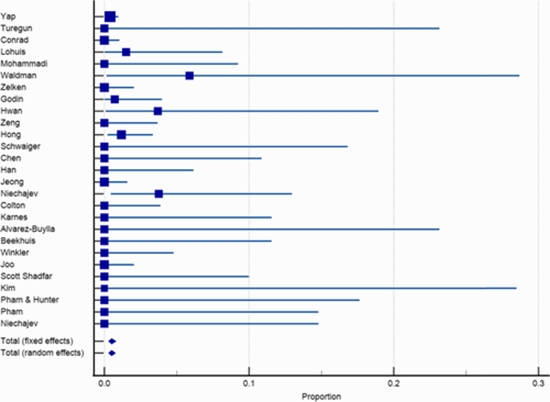
Twenty-seven articles reported on complications and outcomes of dorsal augmentation rhinoplasty with synthetic materials. In a random-effects model, the weighted mean percentage was 2.75% (95% CI 1.61 to 4.17%). the weighted mean percentage were 1.91% (95% CI 0.77 to 3.54%), 0.72% (95% CI 0.316 to 1.31%), and 0.78% (95% CI 0.43 to 1.24%) respectively.
Conclusion
The widely used alloplasts were expanded polytetrafluoroethylene (ePTFE), high-density polyethylene, and silicone. The total rates for complications, infection, deviation, irregularity, hematoma, extrusion, and overcorrection were 2.75%, 1.91%, 0.72%, 0.70%, 0.78%, and 0.49%, respectively. The revision rate, based on the random effects model, was 6.40% with 95%CI (3.84 to 9.57).


comment