Advanced Diagnostic & Interventional Radiology Research Center | Diagnostic Accuracy of Transvaginal Sonography for Deeply Infiltrating Endometriosis and Pouch of Douglas Obliteration in the Presence or Absence of Ovarian Endometrioma
Advanced Diagnostic & Interventional Radiology Research Center | Diagnostic Accuracy of Transvaginal Sonography for Deeply Infiltrating Endometriosis and Pouch of Douglas Obliteration in the Presence or Absence of Ovarian Endometrioma
Diagnostic Accuracy of Transvaginal Sonography for Deeply Infiltrating Endometriosis and Pouch of Douglas Obliteration in the Presence or Absence of Ovarian Endometrioma
Background:
Endometriosis is one of the most common gynecological diseases worldwide. Significant attention has been drawn to this multiorgan and often painful disorder.
Objectives:
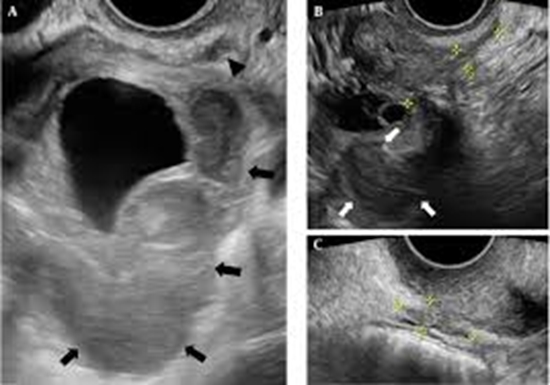
This study aimed to examine the accuracy of transvaginal sonography (TVS) in the diagnosis of deeply infiltrating endometriosis (DIE) with respect to the presence or absence of ovarian endometrioma (OE).
Patients and Methods:
This cross-sectional study was performed on all patients undergoing TVS before gynecological laparoscopy. With pathological confirmation as the standard reference, the diagnostic accuracy of TVS for DIE and pouch of Douglas (POD) obliteration was compared with that of laparoscopy in the anterior and posterior pelvic compartments with respect to the presence or absence of OE. Agreement between TVS and laparoscopy was evaluated for each case, and Cohen’s kappa statistic was measured for each site of involvement. Moreover, sensitivity, specificity, negative and positive predictive values, and likelihood ratios of TVS were calculated, with laparoscopy as the reference test.
Results:
A total of 110 patients, with a mean age of 37.20 ± 7.16 years, were recruited in this study. The accuracy, sensitivity, and negative predictive value of TVS for the diagnosis of DIE and POD obliteration were estimated at 89.5%, 58.3%, and 88.9% in the anterior pelvic compartment and 93.3%, 92%, and 70.6% in the posterior pelvic compartment, respectively. Nevertheless, TVS showed lower sensitivity for detecting pelvic adhesions and peritoneal cysts compared to laparoscopy. The presence of OE did not significantly increase the accuracy of TVS for the diagnosis of DIE or POD obliteration (P > 0.05).
Conclusion:
The present study showed that TVS is an adequately accurate and non-invasive diagnostic tool for the detection and mapping of DIE and POD obliteration, regardless of the presence of OE. TVS may waive the need for exploratory laparoscopy in DIE or at least facilitate precise pre-procedural DIE mapping.





comment