Post Molar Stage I Low Risk Gestational Trophoblastic Neoplasia: Transvaginal Ultrasound Findings and Their Correlation with Chemotherapy Response
Background:
Early diagnosis of gestational trophoblastic neoplasia and its complications are pivotal for prompt and efficacious treatment. Transvaginal pelvic ultrasound could detect myometrial invasion and endometrial thickening following dilation and evacuation of hydatiform mole and also in the assessment of response to chemotherapy.
Objectives:
In this study we aimed to investigate transvaginal ultrasound findings of stage I low-risk gestational trophoblastic neoplasia (GTN) and whether there is an association between ultrasound findings and chemotherapy response.
Patients and Methods:
This study included 31 consecutive patients with postmolar stage I low-risk GTN. We recorded International Federation of Gynecology and Obstetrics (FIGO) score, and transvaginal ultrasound findings including color and pulsed Doppler interrogation at the time of beta human chorionic gonadotropin (β-hCG) rise. The number of Act-D cycles that each patient needed to achieve complete remission was also recorded.
Results:
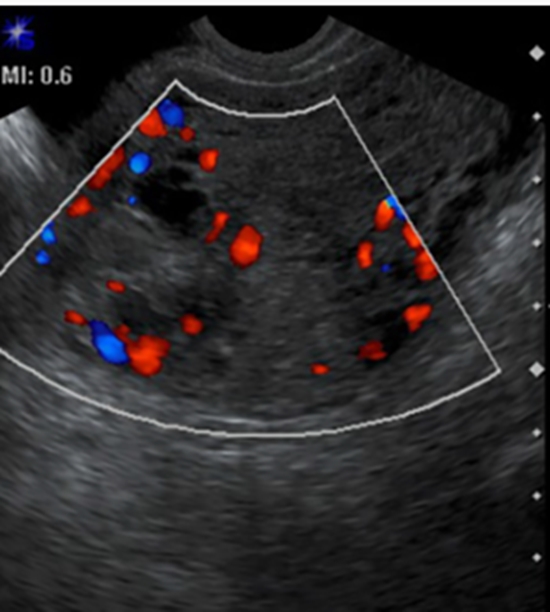
Of the 31 patients with post-evacuation trans-vaginal ultrasound evaluation, 2 (6.5%) patients had no detectable finding, 4 (12.9%) had lesions limited to the endometrium, 12 (38.7%) had lesions with < 50% invasion into myometrium, 7 (22.6%) had lesions with > 50% invasion into myometrium, 4 (12.9%) had lesions that reached uterine serosal surface and 2 (6.5%) had arteriovenous malformation (AVM)-like myometrial lesions. The number of Act-D cycles patients needed to achieve remission was 6 cycles in patients with no finding, lesion limited to endometrium and less than 50% myometrial invasion and was 8 cycles in patients with > 50% invasion ± involvement of serosal surface. One patient in first group and two in second group need multi-agent chemotherapy. But these differences were not significant (P = 0.172).
Conclusion:
There was a non-significant increase in treatment duration and need of multiagent chemotherapy with more extensive ultrasound findings among patients with stage I low risk GTN





Send to friends