


Semiquantitative Dynamic Contrast-Enhanced MRI Accurate Classification of Complex Adnexal Masses
To identify the best dynamic contrast-enhanced (DCE) magnetic resonance imaging (MRI) descriptive parameters in predicting malignancy of complex ovarian masses, and develop an optimal decision tree for accurate classification of benign and malignant complex ovarian masses
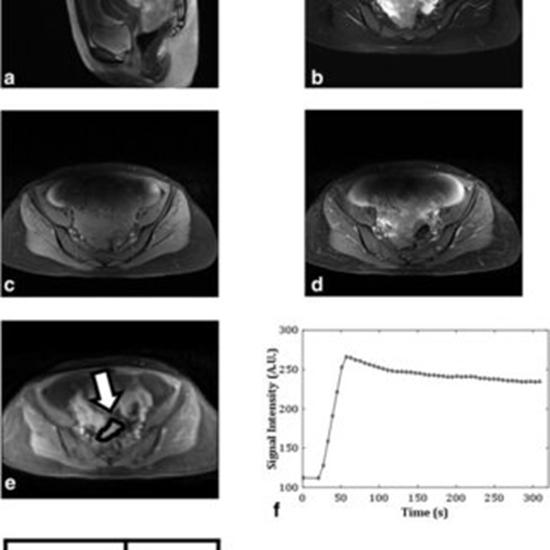
Purpose: To identify the best dynamic contrast-enhanced (DCE) magnetic resonance imaging (MRI) descriptive parameters in predicting malignancy of complex ovarian masses, and develop an optimal decision tree for accurate classification of benign and malignant complex ovarian masses.
Materials and methods: Preoperative DCE-MR images of 55 sonographically indeterminate ovarian masses (27 benign and 28 malignant) were analyzed prospectively. Four descriptive parameters of the dynamic curve, namely, time-to-peak (TTP), wash-in-rate (WIR), relative signal intensity (SIrel ), and the initial area under the curve (IAUC60 ) were calculated on the normalized curves of specified regions-of-interest (ROIs). A two-tailed Student's t-test and two automated classifiers, linear discriminant analysis (LDA) and support vector machines (SVMs), were used to compare the performance of the mentioned parameters individually and in combination with each other.
Results: TTP (P = 6.15E-8) and WIR (P = 5.65E-5) parameters induced the highest sensitivity (89% for LDA, and 97% for SVM) and specificity (93% for LDA, and 100% for SVM), respectively. Regarding the high sensitivity of TTP and high specificity of WIR and through their combination, an accurate and simple decision-tree classifier was designed using the line equation obtained by LDA classification model. The proposed classifier achieved an accuracy of 89% and area under the ROC curve of 93%.
Conclusion: In this study an accurate decision-tree classifier based on a combination of TTP and WIR parameters was proposed, which provides a clinically flexible framework to aid radiologists/clinicians to reach a conclusive preoperative diagnosis and patient-specific therapy plan for distinguishing malignant from benign complex ovarian masses.


Send to friends