


The genotoxic effects of contrast enhanced abdominopelvic 3-tesla magnetic resonance imaging on human circulating leucocytes
Purpose: To evaluate the effects of contrast enhanced abdominopelvic magnetic resonance imaging (MRI) on DNA damage.
Methods: For this study, blood samples of 20 volunteers (15 women and 5 men) with mean age of 43 ± 8 years were assessed. The mean age of women was 41.4 ± 8.9 years and mean age of men was 48.5 ± 4.9 years (P = 0.14). Peripheral blood samples were collected before, 2 and 24 h after MRI in heparin and ethylenediaminetetraacetic acid (EDTA) containing tubes. Heparinized blood was cultured to assess the cytogenetic effects using cytokinesis blocked micronucleus (CBMN) assay. After isolation of mononuclear cells, alterations in genes involved in repair (CHEK2, p21) and apoptosis (BAX, BCL2) were analyzed using real-time polymerase chain reaction (qRT-PCR).
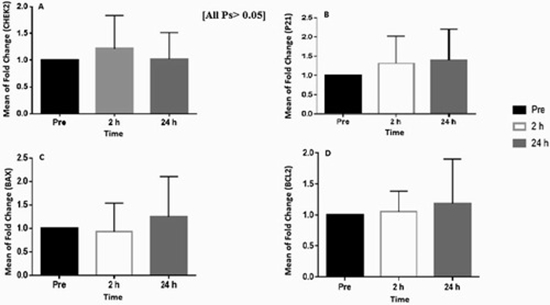
Results: The mean number of MN in binucleated cells at before, 2 and 24 h after MRI were 17.9 ± 2.9, 18.1 ± 2.4 and 18.3 ± 2.6, respectively (p > 0.05). Results of gene expression according to fold change compared with the baseline were 1.2 ± 0.6 and 1.02 ± 0.5 at 2 and 24 h after MRI for CHEK2, and 1.3 ± 0.7 and 1.7 ± 0.7 for CDKN1A (p21); respectively (p > 0.05). Gene expression based on fold change compared with baseline were 0.9 ± 0.6 and 1.2 ± 0.8 at 2 and 24 h after MRI for BAX, and 1.05 ± 0.3 and 1.1 ± 0.7 for BCL2; respectively (p > 0.05).
Conclusion: Contrast enhanced abdominopelvic MRI showed no adverse effect on DNA in terms of MN formation and alterations in expression levels of some genes involved in repair and apoptosis pathways.


Send to friends