


Cerebrovascular reactivity in obstructive sleep apnea: A systematic review using BOLD MRI
Background
Obstructive sleep apnea (OSA) is a major risk factor for stroke and cognitive decline, although its effects on cerebrovascular reactivity (CVR) remain unclear. However, it remains unknown whether blood-oxygen-level–dependent (BOLD) MRI captures consistent CVR impairment or compensatory changes in OSA.
Aim
Here, we systematically synthesize BOLD MRI studies of CVR in adults with OSA to resolve these discrepancies.
Methods
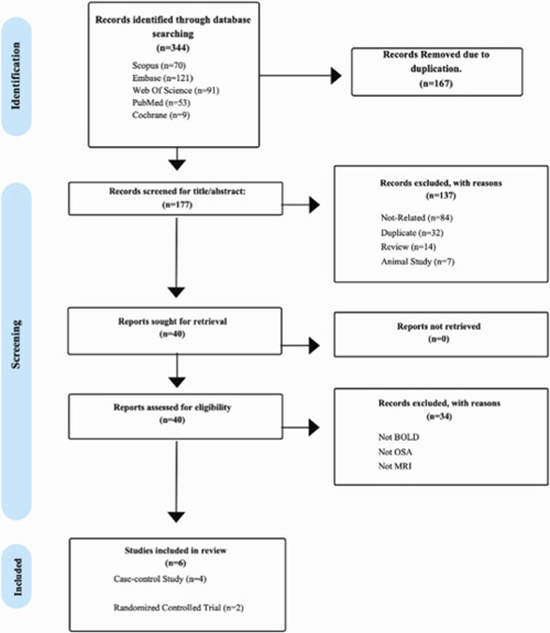
We searched five databases through October 2025 for human studies reporting hypercapnia- or breath-hold–evoked BOLD CVR in polysomnography-confirmed OSA, with duplicate screening, JBI risk-of-bias assessment, and random-effects pooling of PETCO2-referenced %BOLD·mmHg−1 where possible.
Results
Six studies met criteria; four case-control comparisons (n = 84 OSA; n = 55 controls) and two CPAP trials. Contrary to the prevailing view that OSA uniformly blunts CVR, pooled PETCO2-referenced data revealed higher global CVR in OSA than controls (mean difference +0.05 %BOLD·mmHg−1, 95 % CI 0.03–0.06; P < 0.001), with similarly increased grey and white matter reactivity. Studies using alternative CVR metrics uncovered regionally reduced vasodilatory volume or perfusion-based flow reactivity in OSA, aligning previously unresolved dissociations between BOLD and perfusion-derived CVR. Within OSA, one therapeutic CPAP trial demonstrated regional increases in CVR, whereas short-term CPAP withdrawal did not alter BOLD CVR.
Conclusions
These findings reveal that BOLD CVR in OSA is heterogeneous rather than uniformly reduced and establish PETCO2-referenced BOLD MRI as a marker of cerebrovascular dysregulation, providing a new framework for CVR standardisation and opening the door to biomarker-based cerebrovascular risk stratification and CPAP response monitoring.



ارسال نظر