



Modulatory Effects of Methadone on Brain Network Instability in Methamphetamine Use A Cross-sectional Study
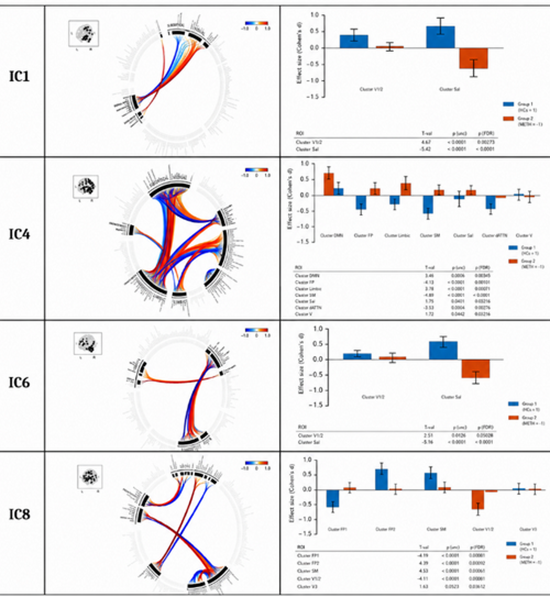
Introduction:While methadone maintenance therapy (MMT) is well established in opioid use disorder, its potentialmodulatory effects on brain network dynamics in methamphetamine use disorder (MUD) remain unclear. This studyaimed to evaluate the association of MMT with normalization of disrupted brain network activity in MUD.Methods:In this cross-sectional study, resting-state functional magnetic resonance imaging (MRI) data were obtainedfrom healthy controls, untreated methamphetamine users, and methamphetamine users receiving MMT who also metdiagnostic criteria for opioid use disorder and were enrolled in supervised MMT programs. Dynamic functional con-nectivity was assessed using dynamic independent component analysis within the CONN toolbox. Clinical status wasevaluated using the Positive and Negative Syndrome Scale (PANSS) and Brief Assessment of Cognition in Schizophrenia(BACS). Group comparisons were performed using general linear models controlling for age, education level, durationof methamphetamine use, and head-motion parameters.Results:110 participants (35 healthy controls, 45 untreatedindividuals with methamphetamine use, and 30 individuals with methamphetamine use receiving MMT) were studied.Cognitive performance assessed using BACS differed significantly across groups (p = 0.002,η² = 0.332), with untreatedmethamphetamine users demonstrating the lowest scores (19.88 ± 6.20), healthy controls the highest scores (30.38± 5.85), and MMT-treated participants showing intermediate performance (22.48 ± 7.61). Compared with untreatedmethamphetamine users, MMT-treated participants showed higher BACS scores, although the methamphetamine ver-sus MMT effect was small-to-moderate (Cohen’s d = -0.38, 95% confidence interval (CI): -0.85 to 0.08). PANSS positive,negative, and general psychopathology scores differed significantly across groups (all p < 0.001), with large effect sizes(η² range = 0.802–0.913). Untreated methamphetamine users exhibited the greatest symptom severity (Cohen’s d = 2.74,95% CI: 2.10–3.38), whereas MMT-treated participants showed lower symptom burden than untreated users (Cohen’s d =2.26, 95% CI: 1.67–2.85), although scores remained elevated relative to healthy controls (d = 4.22, 95% CI: 3.34, 5.11). Themethamphetamine versus MMT effect sizes were large for PANSS positive (Cohen’s d = 2.74, 95% CI: 2.10–3.38), PANSSnegative (Cohen’s d = 2.26, 95% CI: 1.67–2.85), and PANSS general psychopathology (Cohen’s d = 1.64, 95% CI: 1.11–2.18).Conclusion:Methamphetamine use is associated with disrupted and unstable brain network dynamics that may un-derlie acute neurobehavioral disturbances seen in emergency settings. MMT was associated with partial stabilization ofthese alterations, suggesting a potential neurobiological benefit beyond opioid substitution. Persistent network abnor-malities, however, indicate the need for adjunctive therapeutic strategies. Dynamic connectivity measures may offer anovel biomarker for risk stratification and management of substance-related emergencies



ارسال نظر