


Updated trends in the global prevalence and burden of mental disorders, 1990-2023: a systematic analysis for the Global Burden of Disease Study 2023
Background: The 2023 iteration of the Global Burden of Diseases, Injuries, and Risk Factors Study
(GBD) estimated prevalence, incidence, and health burden for 375 diseases and injuries, including
12 mental disorders. We assess past, current, and emerging trends in the prevalence and burden of
mental disorders across sexes and age groups, for 21 regions, 204 countries and territories, and by
Socio-demographic Index (SDI) quintile, from 1990 to 2023.
Methods: Mental disorders included in GBD 2023 were anxiety disorders, major depressive
disorder, dysthymia, bipolar disorder, schizophrenia, autism spectrum disorders, conduct disorder,
attention-deficit hyperactivity disorder, anorexia nervosa, bulimia nervosa, idiopathic
developmental intellectual disability, and a residual category of other mental disorders. A literature
review identified epidemiological data for each disorder. These were analysed via a Bayesian meta-
regression to estimate prevalence by disorder, sex, age, location, and year. Disorder-specific
prevalence was multiplied by disability weights representing the severity of health loss associated
with each disorder to estimate years lived with disability (YLDs). Deaths due to anorexia nervosa
were assessed with a Cause of Death Ensemble modelling strategy to estimate deaths by sex, age,
location, and year, and then multiplied by the standard life expectancy at age of death to estimate
years of life lost (YLLs). YLDs equalled disability-adjusted life-years (DALYs) for all mental disorders
except anorexia nervosa (the only mental disorder considered as an underlying cause of death in
GBD), for which DALYs represented the sum of YLDs and YLLs. We presented prevalence, deaths,
YLDs, YLLs, and DALYs as counts, age-specific rates per 100 000 population, and age-
standardised rates per 100 000 population.
Findings: We estimated 1·17 billion (95% uncertainty interval 1·06-1·31) prevalent cases of mental
disorders globally in 2023, equivalent to an age-standardised prevalence rate of 14 210·7 cases (12
849·5-15 940·1) per 100 000 population. These estimates represented a 95·5% (75·0-121·2)
increase in prevalent cases and 24·2% (11·4-41·4) increase in age-standardised prevalence rate
between 1990 and 2023. All mental disorders showed increases in prevalent cases between 1990
and 2023, while notable increases were seen in age-standardised prevalence rates for anxiety
disorders, major depressive disorder, dysthymia, anorexia nervosa, bulimia nervosa, schizophrenia,
and conduct disorder. There were an estimated 171 million (127-228) DALYs due to mental
disorders globally across sex and age in 2023, equivalent to an age-standardised DALY rate of
2070·5 DALYs (1519·1-2750·5) per 100 000 population. Mental disorders contributed to 6·1% (4·8-
7·6) of all-cause DALYs in 2023, making them the fifth leading cause of global DALYs (up from 12th
in 1990). DALYs were almost entirely composed of YLDs. Mental disorders were the leading cause
of YLDs in 2023 (up from second in 1990), explaining 17·3% (14·8-20·6) of all-cause global YLDs.
Leading causes of mental disorder DALYs were anxiety disorders (ranked 11th among the 304
diseases and injuries at Level 4 of the GBD cause hierarchy), major depressive disorder (15th), and
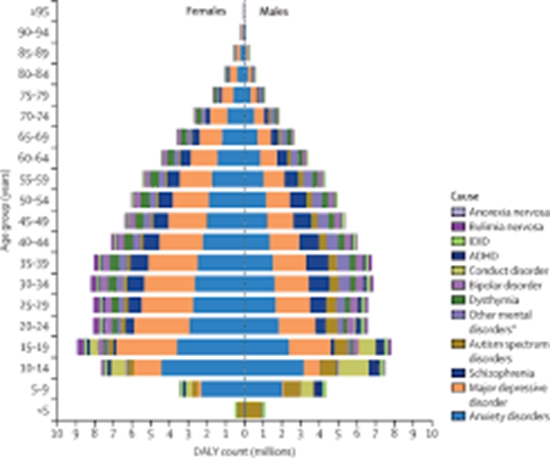
schizophrenia (41st). Globally in 2023, mental disorder age-standardised DALY rates were higher
among females (2239·6 [1643·7-3014·1] per 100 000) than among males (1900·2 [1399·8-2510·8]
per 100 000), and peaked in the 15-19 years age group (2617·3 [1850·6-3696·8] per 100 000). All
locations showed increased mental disorder DALY rates in 2023 compared with 1990, ranging
across countries and territories from 1302·4 (952·7-1683·7) per 100 000 in Viet Nam to 3555·8
(2661·9-4715·0) per 100 000 in the Netherlands. Across SDI quintiles, DALY rates ranged from
1853·0 (1352·1-2469·3) per 100 000 for middle SDI to 2184·1 (1606·1-2890·3) per 100 000 for
high SDI.
Interpretation: A significant health burden was imposed by mental disorders in all countries and
territories in 2023, irrespective of the health resources available. In some instances, this burden
has increased over time and is unevenly distributed across populations. Stronger surveillance
systems, particularly in low-income and middle-income countries, are required. Additionally, we
need more coordinated and inclusive policies to reduce the burden through early treatment and
prevention, tailored to sex and age differences across locations. Responding to the mental health
needs of our global population, especially those most vulnerable, is an obligation, not a choice



ارسال نظر