


Topical selegiline accelerates cutaneous wound healing with phase-specific modulation of MAPK signaling
Background
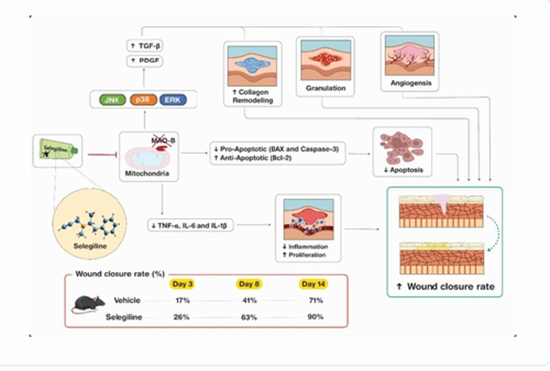
Persistent inflammation, impaired growth-factor signaling, dysregulated apoptosis, and altered signaling-pathway dynamics contribute to delayed cutaneous wound healing. Selegiline, an irreversible monoamine oxidase-B inhibitor with established transdermal delivery, may favorably modulate these interconnected processes within the wound microenvironment.
Methods
Male Wistar rats (n = 90) underwent a full-thickness dorsal excisional wound (~ 25 × 16 mm; ~400 mm²) and were randomly assigned to receive daily administration of vehicle or topical selegiline (0.2%, 0.5%, 1%, or 2% w/w). Wound closure was assessed on Days 3, 8, and 14, and tissues were harvested for hematoxylin and eosin–based histopathological scoring; quantification of interleukin-1 beta (IL-1β), IL-6, tumor necrosis factor-alpha (TNF-α), platelet-derived growth factor (PDGF), transforming growth factor beta (TGF-β), apoptotic biomarkers, extracellular signal-regulated kinase (ERK), mitogen-activated protein kinase (MAPK) p38, and c-Jun N-terminal kinases (JNK) transcripts.
Results
Topical selegiline accelerated wound closure in a dose-dependent manner, with greatest efficacy at 1–2% (86.18% (1%) and 90.28% (2%)), compared with 70.58% in the vehicle group. Histopathology showed reduced inflammation and more advanced granulation/angiogenesis and collagen organization. Selegiline reduced the injury-associated elevation of IL-1β, IL-6, and TNF-α, particularly at later time points, and was associated with enhanced PDGF and TGF-β during proliferative/remodeling phases, shifted apoptosis toward a pro-survival profile, and produced phase-linked changes in ERK/JNK/p38 transcripts.
Conclusions
Topical selegiline was associated with faster excisional wound repair, most consistently at 1–2%, by accelerating closure and coordinating inflammatory resolution, growth-factor recovery, apoptosis balance, and MAPK-related signaling across healing phases. These findings support further preclinical evaluation of topical selegiline, including mechanistic validation, local and systemic safety assessment, pharmacokinetic characterization, and investigation in impaired or chronic wound models.


ارسال نظر