


Differentiating malignant from benign breast masses: a multiparametric magnetic resonance imaging (MRI)-based radiomics approach with machine learning
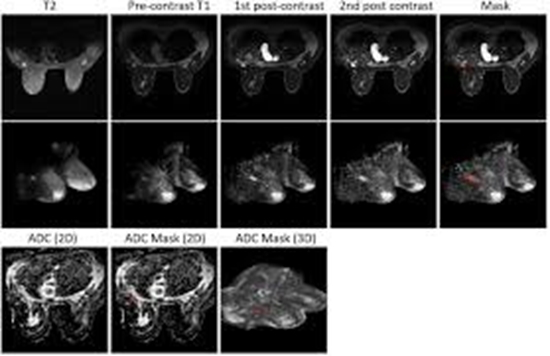
Aim: We evaluated the performance of radiomics models based on multiparametric magnetic resonance imaging (MRI; dynamic contrast-enhanced, T2, and apparent diffusion coefficient (ADC) sequences) in differentiating malignant from benign masses. Various combinations of MRI sequences were compared.
Materials and methods: One hundred forty-four patients with breast lesions (69 malignant and 75 benign) were retrospectively analysed. After manual segmentation, 107 shape- and texture-based features were extracted from each lesion. Support vector classifier, random forest, and k-nearest neighbours were trained to distinguish malignant and benign lesions. The models were evaluated with seven different input image sets: five single-sequence images and two combined sets (all sequences vs all contrast-free sequences).
Results: Single-sequence models achieved similar accuracies for ADC, pre-contrast T1, and post-contrast T1, while T2 models showed slightly lower accuracy. The all-sequence model achieved an average accuracy of 0.88, outperforming the single-sequence models. The contrast-free sequence models (T2, ADC, and pre-contrast T1) yielded an average accuracy of 0.90, comparable to the all-sequence model.
Conclusion: Non-contrast MRI radiomics algorithms have the potential for clinical implementation as complementary tools, potentially eliminating the need for contrast in MRI studies.


ارسال نظر